
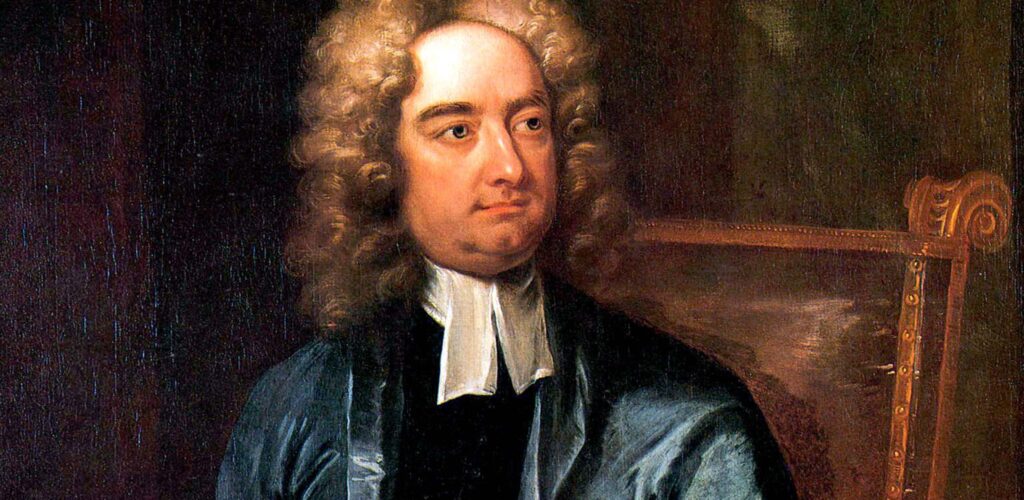
Three centuries after taking Lemuel Gulliver to the shores of Lilliput, Jonathan Swift is symbolically taking to the road once again. In 2026, Ireland is celebrating the 300th anniversary of Gulliver’s Travels with a series of exhibitions, conferences, performances and visits organised at places that shaped the writer’s life. From Dublin’s St Patrick’s Cathedral to the historic shelves of Armagh’s Robinson Library, this tercentenary reveals the full significance of a book that is far more political than its appearance as an adventure story might suggest.
A landmark of Irish literature published in 1726
On 28 October 1726, a work destined for an exceptional future was published in London by Benjamin Motte: Travels into Several Remote Nations of the World, now known under the title Gulliver’s Travels.
Its author, Jonathan Swift, initially concealed his identity behind that of Lemuel Gulliver, a naval surgeon presented as the narrator of his own adventures. The book took its readers to imaginary territories populated by tiny beings, giants, scholars absorbed in absurd research and horses endowed with reason.
This apparent fantasy concealed a particularly sharp attack on power, religious quarrels, political institutions, scientific pretensions and human weaknesses. Beneath the mask of the extraordinary voyage, Swift observed eighteenth-century Europe with an irony from which few politicians, courtiers or scholars emerged unscathed.
Three hundred years later, the words invented or popularised by the story continue to circulate. “Lilliputian” still describes something extremely small, while Brobdingnag remains associated with the world of giants. Translated, abridged, illustrated and adapted in very many countries, the text now belongs to a global imagination.
Jonathan Swift, the writer at the heart of Dublin
A life closely linked to the history of the Irish capital
The tercentenary of Gulliver’s Travels invites visitors to rediscover Dublin through the life of Jonathan Swift. Born in 1667 in the Irish capital, the writer studied at Trinity College before becoming dean of St Patrick’s Cathedral in 1713. He held this position until his death in 1745.
Swift was not only a clergyman and a satirical author. He regularly intervened in the political and economic debates of his time, particularly to denounce poverty and defend Ireland’s interests in the face of British power. This outrage at injustice runs through much of his work.
The places associated with the writer now form a genuine literary itinerary in Dublin. Trinity College, St Patrick’s Cathedral and Marsh’s Library are located within a few kilometres of one another. Together, they make it possible to follow the young student, the man of letters, the clergyman and the pamphleteer.
St Patrick’s Cathedral preserves Swift’s memory
The final refuge of the dean and his “savage indignation”
St Patrick’s Cathedral is the essential stop on this journey through Jonathan Swift’s Dublin. The writer served as dean there for more than thirty years and was buried there after his death on 19 October 1745. His grave lies near that of Esther Johnson, known as Stella, who held a major place in his life.
The cathedral preserves several objects and documents connected with Swift, including early editions of his writings, commemorative sculptures and the pulpit from which he preached. A table used to celebrate the Eucharist in his church at Laracor, near Trim, is also on display there.
His Latin epitaph, composed by the writer himself, refers to this “savage indignation” that could no longer tear at his heart. It invites the passer-by to imitate, if possible, the man who fought with all his strength for freedom. Few texts sum up Swift’s temperament and the contained violence of his satire so clearly.
For the tercentenary, the cathedral is taking part in several events dedicated to the author. The announced programme notably includes conferences, concerts, storytelling, workshops and a guided night-time tour organised as part of the Jonathan Swift Festival.
Trinity College delves into Gulliver’s world
An exhibition presented at the university where Jonathan Swift studied
Jonathan Swift entered Trinity College Dublin in 1682. Almost three and a half centuries later, his portrait still watches over the Old Library: a marble bust of the writer is among those lining the famous Long Room.
In 2026, the university is devoting an exhibition to the tercentenary of Gulliver’s Travels. Presented from July onwards, it explores the writing of the book, its satirical significance and the personality of its author.
The setting could hardly be more evocative. Founded in 1592, Trinity College is one of the great sites of Ireland’s literary heritage. Its historic library is also associated with the Book of Kells, the famous illuminated manuscript produced around the ninth century.
The exhibition places Gulliver’s Travels within a literary tradition that goes far beyond a story intended for young readers. Behind the best-known episodes lies a book about power relations, institutional corruption and the pride of a humanity convinced of its own superiority.
Marsh’s Library displays Gulliver’s many faces
Editions from Europe and Asia brought together in Dublin
Just a few steps from St Patrick’s Cathedral, Marsh’s Library provides one of the most intact settings of eighteenth-century Dublin. Opened in 1707, it is considered Ireland’s oldest public library. Jonathan Swift visited it as a reader and also served on its board of governors.
Until 12 September 2026, the institution is presenting the exhibition Gulliver 300: 1726-2026. The books brought together bear witness to the novel’s international spread and its ability to cross languages, political systems and generations.
The exhibition notably brings together Ukrainian and Chinese editions, as well as a Japanese manga adaptation. A children’s version, designed in the form of a pop-up book, also illustrates how the story was transformed to reach new audiences.
These publications show how far Swift’s work escaped its original context. Lilliput and its inhabitants have successively been used as political figures, children’s literature characters and popular culture heroes. The novel has changed form without losing its unsettling ability to hold up a mirror to its readers.
In Armagh, the copy corrected by Jonathan Swift
Robinson Library preserves a major piece of the novel’s history
The tercentenary also takes travellers to Armagh, in Northern Ireland. Robinson Library there preserves an exceptional copy of the first edition of Gulliver’s Travels, published by Benjamin Motte in 1726.
This large-format copy contains handwritten corrections attributed to Jonathan Swift. The writer had discovered that his publisher had modified or removed certain passages, presumably to limit the risks associated with the force of his political and social attacks.
Disappointed by this version, Swift is said to have annotated the margins of the book to indicate the alterations made to his text. The copy, permanently displayed in the library’s Long Room, is therefore a particularly valuable witness to the difficult relationship between the author, his publisher and censorship in the eighteenth century.
An exhibition scheduled from July to December 2026 examines the novel from several angles: society, politics, science, education and the conception of human nature. On 26 November, Robinson Library will also host a conference dedicated to the relevance of Gulliver’s Travels today and the place of satire three centuries after its publication.
The Dublin Festival of History revisits Swift’s Ireland
Manuscripts and rare editions expected in the autumn
From 26 September to 11 October 2026, the Dublin Festival of History is also due to take part in the commemorations. Dublin City Library and Archives are notably planning an exhibition bringing together manuscript documents, rare editions and a first French translation of Gulliver’s Travels.
This programme will place the novel within eighteenth-century Irish society, at a time marked by deep inequalities, political tensions and an economic dependence that Swift denounced on several occasions.
On 10 October, St Patrick’s Cathedral will also host a conference by historian and author Hester Grant. She will focus on the months preceding the novel’s publication, Swift’s relationships and the events that may have fuelled his writing. Admission is announced as free, but subject to booking.
The Jonathan Swift Festival will bring the Gulliver year to a close
Nine days of literary events in Dublin
The Jonathan Swift Festival will be one of the major events of this tercentenary. Scheduled to take place from 18 to 26 November 2026 in Dublin, it is set to bring together conferences, debates, choral concerts, storytelling, workshops and heritage tours.
The announced events include an evening of talks entitled Craicademia: Gulliver Special, a night-time tour of St Patrick’s Cathedral and a gala dinner dedicated to Gulliver.
This programme is not merely seeking to honour a work from the past. It questions the book’s ability to withstand the passage of time. For the tiny nations obsessed with their conflicts, the leaders blinded by their vanity and the scholars cut off from the world described by Swift have lost none of their power to evoke.
By following Jonathan Swift’s footsteps from Dublin to Armagh, Ireland thus reminds us that Gulliver’s Travels is not merely an adventure populated by extraordinary creatures. It remains one of the fiercest stories ever written about power, reason and the contradictions of human beings.