

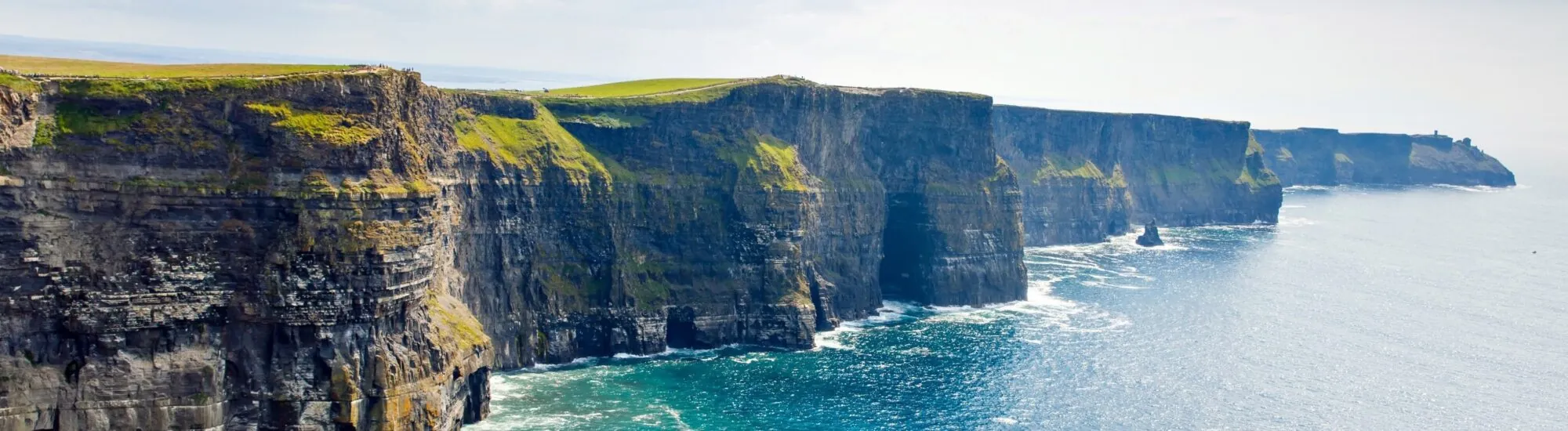
Vertiginous, wild and battered by the Atlantic, the Cliffs of Moher are among Ireland’s most famous landscapes. Located on the west coast of County Clare, south-west of the Burren, they stretch for around 8 km and rise to 214 metres above the ocean. On a clear day, the views extend to the Aran Islands, Galway Bay and the mountains of Connemara.
The panorama alone makes the trip worthwhile, but a successful visit requires a little planning. Opening times vary by season, the site is busy around midday, the weather is changeable and much of the coastal path is closed: here is what you need to know to visit the Cliffs of Moher in good conditions.
The official site, known as the Cliffs of Moher Experience, is open all year round, except on 24, 25 and 26 December. The published opening times are as follows:
In 2026, the official ticket office offers adult admission from €8, senior and student tickets from €6, and free admission for children aged 12 and under, up to a maximum of four children per booked adult. Prices vary according to the time slot and may be higher during the busiest period. Booking online generally gives you the best price and allows you to choose your time slot.
The ticket includes parking in the main car park, access to the visitor centre, exhibition, secured viewing platforms and, when open, O’Brien’s Tower. It is therefore no longer simply a ‘per-person parking charge’, as it was sometimes described in the past, but admission to the full experience.
Allow between 1.5 and 2.5 hours to enjoy the main viewpoints and visit the visitor centre at an unhurried pace. Half a day is worthwhile if you want to take your time, watch birds or wait for a break in the weather. As opening times and prices may change, check the official Cliffs of Moher website before setting off.
The Cliffs of Moher are on the R478, between the villages of Liscannor and Doolin, on the Wild Atlantic Way. The main entrance and car park for the Cliffs of Moher Experience are at approximately 52.9715, -9.4309.
By car, the site can be reached from Galway, Ennis, Limerick or Doolin. Roads in the Burren are sometimes narrow and winding, so it is better to allow extra time rather than rely on the most optimistic journey time shown by your GPS.
It is also possible to visit the Cliffs of Moher without a car. Bus route 350 links Ennis and Galway via Lahinch, the cliffs and Doolin. Since 2025, it has operated ten daily services in each direction. Route 351 complements this service between Galway and the cliffs. Timetables should be checked with Transport for Ireland before travelling.
From 21 May to 20 September 2026, the Burren & Cliffs Explorer Shuttle Bus serves several sites and villages in north and west Clare, including the Cliffs of Moher, free of charge. The service operates without advance booking, but a seat is not guaranteed.
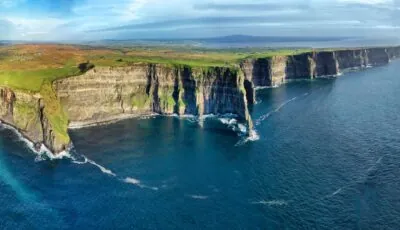
Panoramic view of the Cliffs of Moher
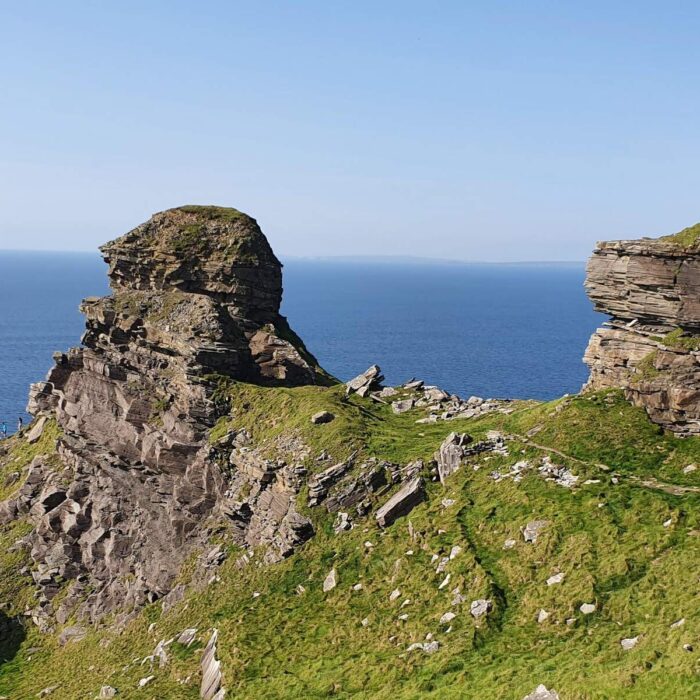
From the visitor centre, a landscaped path leads to the main viewing platforms. Here, the scale of the site becomes clear: dark layers of shale and sandstone plunge almost vertically into the Atlantic, while waves crash at the foot of the cliffs.
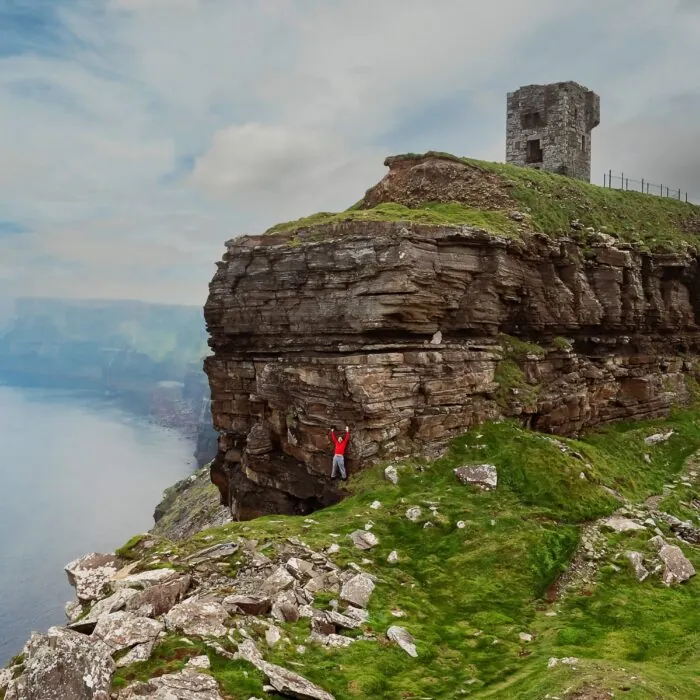
Built in 1835 by the landowner Cornelius O’Brien, O’Brien’s Tower is the site’s iconic landmark. It was designed as an observation tower for visitors, evidence that the Cliffs of Moher were already attracting travellers in the 19th century. Entry is included in the ticket when the tower is accessible, but it may close because of wind, weather or operational constraints.
The North Platform, near the summit of Knockardakin, offers wide-open views over the cliffs, Galway Bay and, in clear weather, the Twelve Bens and Maumturks mountains in Connemara. To the south, the platforms offer views of the succession of cliff faces as far as Hag’s Head.
The Cliffs of Moher also appear in Harry Potter and the Half-Blood Prince. They provide the exterior setting for the cave sequence sought by Harry and Dumbledore, although the rock seen offshore was digitally added to the site.
It is currently not possible to walk freely along the entire coastal path between Liscannor, the Cliffs of Moher and Doolin. This information is essential: older guides still recommend the full walk, but several sections are closed for serious safety reasons.
In 2026, the southern section between Liscannor/Hag’s Head and the Cliffs of Moher Experience, around 6 km long, is completely closed. To the north, the path is accessible from Doolin only as far as Surfers Path; you must then turn back, with no possibility of reaching the official site. Do not cross fences or use closed sections, even if a GPS track or older article still shows them as passable.
For a safe walk, the official site offers around 3.5 km of landscaped paths and protected viewpoints. A section north of O’Brien’s Tower was renovated in 2025. Stay behind barriers and on authorised routes: the wind can throw you off balance, the ground becomes slippery in rain and the cliff edge is subject to erosion.
Visibility matters more than the season. In light rain, the landscape retains a dramatic atmosphere; in fog, however, the cliffs can almost disappear entirely. Check the local weather on the morning of your visit and keep your plans flexible if the cliffs are a highlight of your trip.
From May to September, time slots before 11 am and after 4 pm are generally more pleasant than the middle of the day, when tour coaches are most numerous. In summer, opening until 9 pm makes it possible to enjoy softer light later in the day. In winter, visitor numbers fall, but wind, rain and closures due to extreme conditions are more likely.
Even in high summer, bring warm clothing, a waterproof windproof jacket and shoes with good grip. An umbrella is rarely practical on this very exposed headland. The site may close temporarily when conditions become dangerous: always follow the instructions displayed at the entrance.
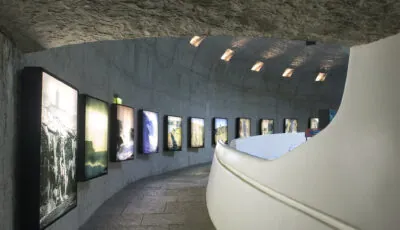
The Cliffs of Moher visitor centre
Opened in 2007, the visitor centre was largely built into the hillside to limit its visual impact. Its Atlantic Edge exhibition presents the geology, wildlife, flora and human history of the cliffs. A short immersive experience, The Ledge 4D Experience, also offers a virtual exploration of the site above and below the ocean.
The building houses food outlets, a shop and several craft workshops. The opening times for these services may differ from those of the site. The centre is useful for understanding the landscape better and taking shelter, but the outdoor platforms are, of course, the heart of the visit.
The visitor centre and main paths have accessible facilities. Reserved spaces are available in the main car park and near the centre, while wheelchairs can be borrowed from the car park office or reception. However, the terrain, slopes and wind can make some sections more demanding; ask staff for advice based on the day’s conditions.
Families can visit, provided young children are kept close and never allowed to run near exposed areas. The secured platforms allow visitors to take in the landscape without approaching the drop. Dogs must remain under control, and the instructions displayed on site must be followed, particularly near nesting birds.
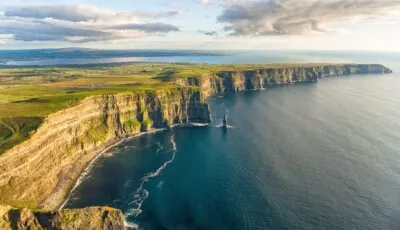
The Cliffs of Moher, a protected natural area
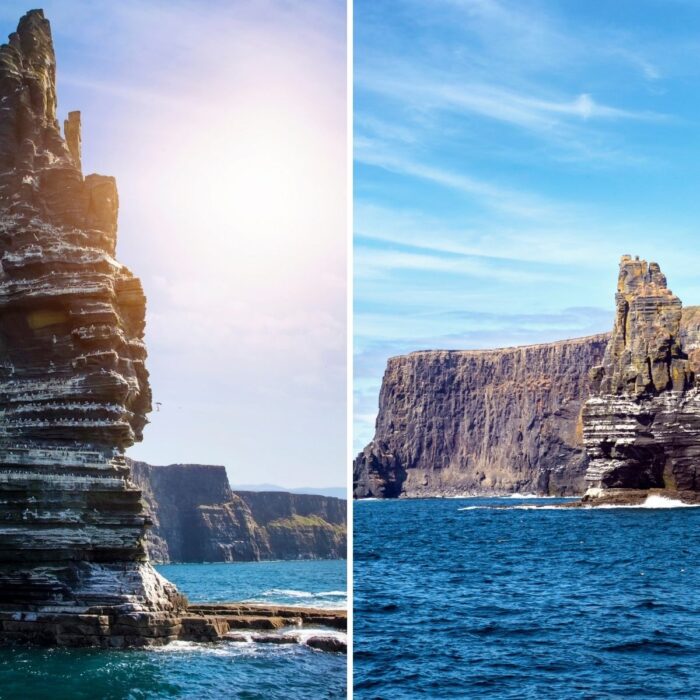
The cliff faces formed more than 300 million years ago from sediments deposited in an ancient delta. The alternating shale and sandstone now create the long horizontal layers characteristic of the landscape.
The Cliffs of Moher form part of a Special Protection Area within the Natura 2000 network. They are home to a large assemblage of breeding seabirds, including fulmars, kittiwakes, guillemots, razorbills, Atlantic puffins and choughs. Puffins are mainly present during the breeding season, roughly from spring to early summer, but sightings are never guaranteed.
To limit erosion and disturbance to wildlife, stay on designated paths, do not cross fences, take your litter home and observe birds from a distance. These simple actions protect the site while preventing the creation of dangerous informal paths along the cliff edge.
Many day trips travel to the Cliffs of Moher from Galway, Dublin, Cork or Limerick. From Dublin or Cork, the day is long and much of the itinerary is spent on the road. If your itinerary allows, a visit from Galway, Doolin, Lahinch or Ennis offers more flexibility.
From Doolin, seasonal cruises offer the chance to see the cliffs from the sea. This perspective reveals their height and the bird colonies nesting on the ledges. Trips remain dependent on sea conditions and can be rough: bring waterproof clothing and plan for seasickness.
You can compare guided tours offered by GetYourGuide. Before booking, check how long is actually spent at the site, the additional stops on the tour and the cancellation terms.
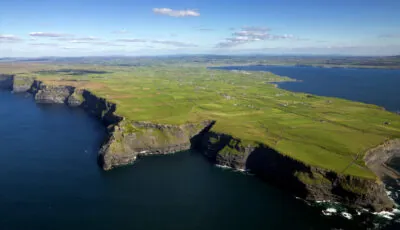
The Cliffs of Moher facing the Atlantic
According to a County Clare tradition, the city of Kilstiffen, or Cill Stuifin, is said to lie beneath the Atlantic. It is thought to have sunk after the loss of a golden key that opened the gates of its castle. The city could only rise to the surface again if the key were found. Other versions say that it reappears periodically and that seeing it foretells a grim fate. These stories are, naturally, folklore rather than established history.
Another legend features Mal and the hero Cú Chulainn. In love with the warrior but not loved in return, Mal is said to have pursued him to the Clare coast. Cú Chulainn reportedly leapt nimbly across the rocks, while Mal missed her jump and died at the foot of the cliffs. The shape of Hag’s Head, which resembles a face turned towards the ocean, is associated with this story. The tale has several local variations, so it is best presented as a legend rather than as an explanation for the colour of the rocks.
Allow around 1.5 to 2.5 hours to see the main platforms, O’Brien’s Tower and the visitor centre. Half a day allows for a more relaxed visit.
The landscape itself is not subject to a toll as such, but access to the official site, its facilities and its car park requires a ticket. External paths must not be used to bypass closures or enter private areas.
Online tickets start at €8 for an adult and €6 for a senior or student. Children aged 12 and under enter free of charge, subject to conditions. The price depends on the chosen time slot.
No. In 2026, the northern section is open from Doolin only as far as Surfers Path. You must then retrace your steps: it is not possible to reach the Cliffs of Moher Experience via this path.
Before 11 am or after 4 pm, visitor numbers are generally lower. However, weather and visibility remain decisive.
Yes, especially during their nesting season, from spring to early summer. They are small and difficult to make out from the top of the cliffs, so binoculars are useful.
Want to extend your visit without having to rush around? Here are a few well-located places to stay near the must-see attractions.
Essential information to help you plan your visit, including key landmarks, access information, and booking options.
52.9727125117566, -9.430105137617478
1 heure
Compare tickets, guided tours, and excursions available through our partner platforms.