

Dimly lit corridors, bare-walled cells and a yard where fourteen men were shot in May 1916: in Dublin, Kilmainham Gaol preserves the memory of some of the most painful chapters in Irish history.
Opened in 1796 and closed in 1924, this former prison held ordinary criminals, women, children, victims of the Great Famine and many figures from the independence movement. Now a museum, it offers a clearer understanding of the evolution of the prison system and the struggles that led to the creation of the Irish state.
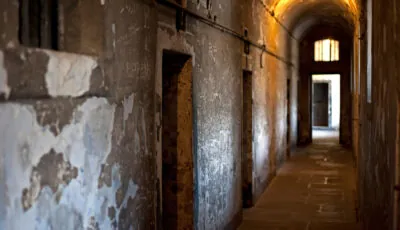
Inside Kilmainham Gaol – © samjanssens
Kilmainham Gaol can only be visited with a guide. The tour takes in the oldest parts of the prison, the striking east wing, the Catholic chapel and the Stonebreakers’ Yard, where the principal leaders of the Easter Rising were executed.
The visit does not attempt to turn the prison into a dramatic attraction. Instead, it recounts the conditions of imprisonment, the workings of the institution and the fate of those held there. The registers, letters, personal belongings and photographs on display place major political figures alongside the thousands of ordinary prisoners now forgotten.
The building remains cold, even when the weather outside is mild. The stonework, draughts and poorly heated cells give a very real sense of the environment in which prisoners lived.
Kilmainham Gaol opened in 1796 under the name New Gaol. It replaced an older prison near present-day Mount Brown, where sanitary conditions and security had become particularly concerning.
The new institution was designed by the architect John Trail amid the first European prison reforms. At the time, thinkers such as John Howard condemned overcrowding, corrupt gaolers and the lack of hygiene in prisons.
In theory, the new Kilmainham prison was intended to separate prisoners and provide better supervision of their daily lives. It was built on an elevated site known as Gallows Hill, where the air was considered healthier and drainage more effective.
Its original layout included a central building for the guards and two wings housing the cells. The complex was enclosed by a massive wall, reaching nearly fifteen metres high in places.
Despite the reforming ambitions behind the project, prison conditions remained extremely harsh. In the oldest section, now known as the west wing, the cells initially had neither heating nor permanent lighting. The windows had not yet been fitted with glass, allowing cold and damp to enter.
Prisoners had only candles, distributed sparingly. Before gas lighting was installed in the 1840s, these were their sole source of light and warmth. They used chamber pots kept inside their cells.
Food varied according to the period and the prisoner’s category. In the mid-19th century, a man’s daily ration might consist only of maize porridge and milk in the morning, followed in the evening by bread with milk, oatmeal or soup.
Men sentenced to hard labour broke stones in the yard. Women worked mainly in the laundry. Prisoners generally had only one hour of outdoor exercise a day.
Political prisoners gave Kilmainham Gaol its place in history, but they made up only a small part of its population. Most of those imprisoned were ordinary offenders.
When the prison opened, almost half its inmates were imprisoned for debt. Others were held for theft, assault, counterfeiting, illicit distilling, begging or more serious crimes. Some offences now seem trivial: people could be convicted for stealing food or a few pieces of fruit.
Men, women and children were for many years held in the same institution without adequate separation. Babies under one year old sometimes stayed with their mothers throughout their sentences. Children sentenced to more than two weeks in custody received a few lessons from the chaplain.
People with mental health conditions were also imprisoned as criminals, owing to the lack of suitable facilities. The prison thus reflected the deep social inequalities of 18th- and 19th-century Ireland.
The Great Famine, which struck Ireland from 1845, transformed life in the prison. The loss of potato crops plunged much of the population into hunger. Food theft and begging became increasingly common.
The Vagrancy Act of 1847 worsened the situation further by making it easier to arrest people forced to beg. Some deliberately committed minor offences in the hope of finding shelter and regular food rations in prison.
Kilmainham Gaol quickly became overcrowded. Cells intended for one person held up to five prisoners. Others slept on straw in corridors and communal rooms.
Overcrowding, malnutrition and poor hygiene encouraged the spread of disease. Fever and dysentery claimed many lives. Rations were even reduced when the authorities realised that prison food might seem preferable to the famine outside.
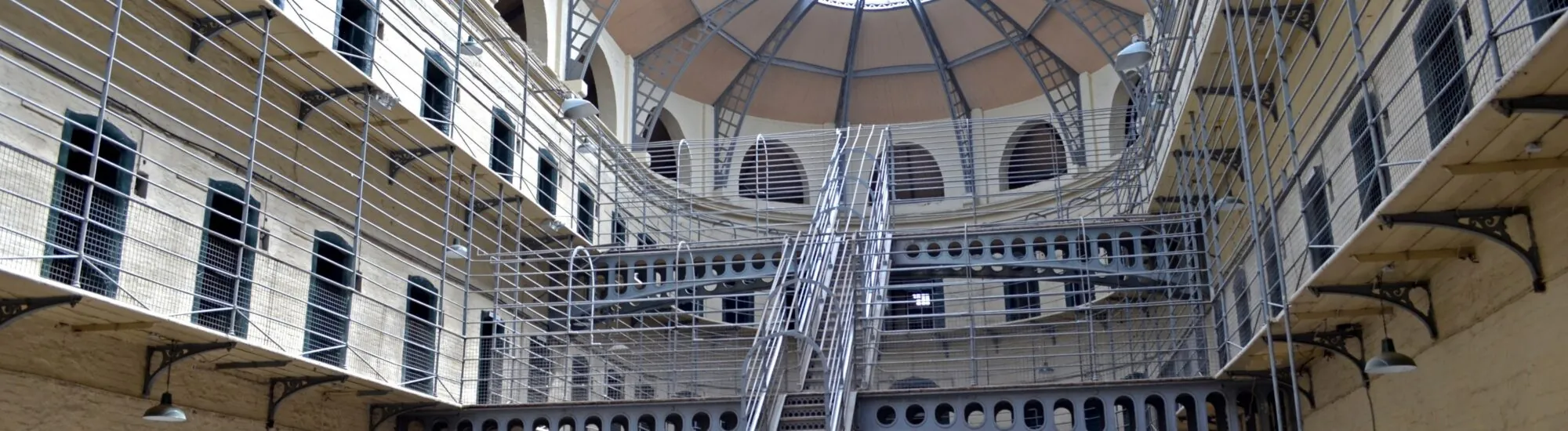
To address the shortage of space and apply new penal theories, a modern wing was built in the early 1860s. Designed by the architect John McCurdy, it contains 96 cells arranged around a vast central space.
Its architecture was inspired by Jeremy Bentham’s panopticon principle. From a central platform, guards could observe the doors of every cell at once. Prisoners, meanwhile, did not know when they were actually being watched.
A huge glass roof illuminates the entire wing. In Victorian thinking, light was meant to contribute to a prisoner’s moral purification. Inside the cells, the windows were placed too high to allow a view outside: symbolically, prisoners were invited to turn their gaze towards the sky.
Beneath this bright wing, however, are several disciplinary cells almost entirely shrouded in darkness. The search for modern prison architecture remained inseparable from a system based on isolation and obedience.
This Victorian gallery is now the most recognisable part of Kilmainham Gaol. It appears in the films Michael Collins, In the Name of the Father and The Commitments, as well as in several productions about Irish history.
During the first half of the 19th century, Kilmainham Gaol served as a detention centre for convicts awaiting transportation. Men and women could wait there for several months before being transferred to a port and sent to Australia.
Transportation was imposed for serious crimes, but also for relatively minor offences. It took convicts to Van Diemen’s Land, now Tasmania, or to other British colonies.
The museum holds, among other items, the small wooden box of John Sheahan, who was sentenced in 1842 to seven years’ transportation. This simple object contained all the possessions he was able to take when he left for Tasmania.
Kilmainham Gaol’s political history began with the major uprisings of the late 18th century. Members of the United Irishmen were held there after the 1798 rebellion. Robert Emmet was imprisoned there before his execution in 1803.
During the 19th century, the prison held Young Ireland activists, Fenians and nationalist leaders. Charles Stewart Parnell was imprisoned there in 1881 with several members of the Irish Parliamentary Party.
The most privileged political prisoners could enjoy considerably better conditions. Parnell, for instance, was allowed to furnish several cells with his own belongings and receive visitors more freely. This difference in treatment contrasted with the situation of poor prisoners held in the darkest wings.
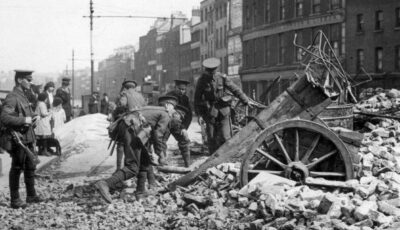
The 1916 Easter Rising – Public domain
After the failure of the 1916 Easter Rising, Kilmainham Gaol was reopened to hold hundreds of men and women arrested in Dublin.
Between 3 and 12 May 1916, fourteen leaders of the rebellion were executed by firing squad in the Stonebreakers’ Yard. Patrick Pearse, Thomas Clarke and Thomas MacDonagh were the first to die.
Joseph Plunkett married Grace Gifford in the prison’s Catholic chapel just hours before his execution. The ceremony took place at night, by candlelight and under military guard.
James Connolly was the last of the fourteen men executed at Kilmainham. Seriously wounded during the fighting, he could not stand and was shot while seated on 12 May 1916.
The executions, carried out over a very short period, caused a profound shift in public opinion. Part of the population, initially hostile or indifferent to the uprising, began to see the rebels as martyrs for the Irish cause.
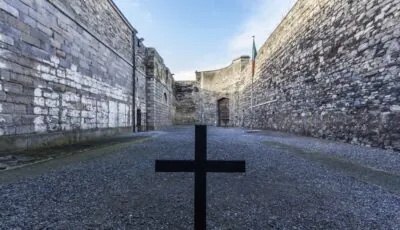
The yard where the leaders of 1916 were executed – © Paulo Nabas
The Stonebreakers’ Yard was originally an area for hard labour. Men sentenced to arduous work broke stones by hand there, sometimes separated from one another by small shelters.
The yard became Kilmainham Gaol’s main site of remembrance after the 1916 executions. Two crosses now mark the locations associated with the shootings. A plaque bears the names of the fourteen men executed.
The space is deliberately austere. The high walls, cobblestones and two crosses are enough to evoke the events. Guides recount the prisoners’ final hours without excessive staging.
The prison held new inmates during the Irish War of Independence, between 1919 and 1921. Members of the IRA involved in the attack on and burning of the Custom House were among those imprisoned there.
In 1921, some prisoners managed to smuggle in cameras. Their photographs reveal an unexpected daily life of Irish-language classes, plays, communal meals and boxing matches. These photographs are displayed in a temporary exhibition running until 31 October 2026.
After the signing of the Anglo-Irish Treaty, civil war broke out between supporters and opponents of the agreement. Kilmainham Gaol came under the control of the Irish Free State and held many republican prisoners, including several hundred women.
Éamon de Valera was among the last prisoners to leave the gaol in 1924. Kilmainham Gaol closed permanently in July that year.
Many political leaders and revolutionaries passed through Kilmainham Gaol between 1796 and 1924. The best known include:
The presence of these figures should not overshadow the thousands of unnamed people imprisoned for debt, poverty or minor offences. The museum now gives significant attention to their stories, as well as those of the women and children held in the institution.
After its closure, the prison was abandoned for several decades. Roofs deteriorated, windows disappeared and the yards were gradually overgrown with trees, ivy and brambles.
In the late 1950s, a group including former independence fighters mobilised to save the building. The Kilmainham Jail Restoration Society was established with the aim of turning the prison into a memorial before the fiftieth anniversary of the Easter Rising.
Volunteers began by clearing the yards, removing vegetation and strengthening the structures. Craftspeople worked for free in the evenings and at weekends. Up to two hundred people took part in some projects at the same time.
The first part of the museum opened in the east wing in April 1966, in the presence of President Éamon de Valera. Restoration work then continued for twenty years. In 1986, Kilmainham Gaol came under the responsibility of the State and the Office of Public Works.
The guided tour of the building lasts around one hour. It takes in the west wing, east wing, Catholic chapel and Stonebreakers’ Yard. The exact route may vary depending on works or conservation requirements.
The ticket also includes admission to the museum. Its permanent exhibition explores the social history of Irish prisons, nationalism between 1796 and 1924, and the restoration of the building in the 20th century.
The collection comprises nearly 10,000 objects, including convicts’ letters, photographs, newspapers, uniforms and personal belongings. The museum notably holds an original copy of the 1916 Proclamation, the crucifix held by Patrick Pearse before his execution and Michael Mallin’s last letter to his family.
The full visit takes around 1 hour 30 minutes. The building is old and has several access difficulties, but a ground-floor route can be arranged for wheelchair users or people with mobility issues. The museum should be contacted before booking.
The prison is not recommended for children under 6 because of the length of the visit and the nature of the stories covered. Pushchairs, wheeled suitcases and large luggage are not permitted during the visit.
Bookings must be made exclusively through the official Kilmainham Gaol Museum website or Heritage Ireland. Tickets offered by third-party platforms are not recognised by the museum.
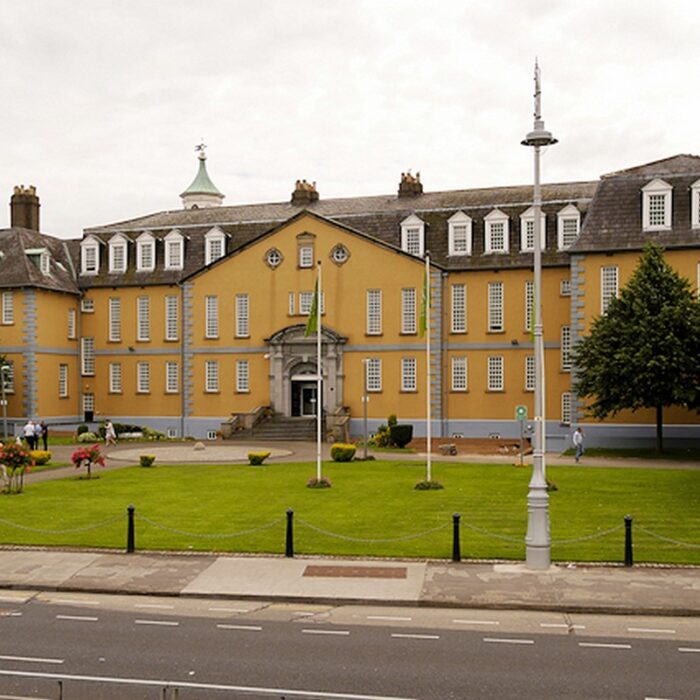
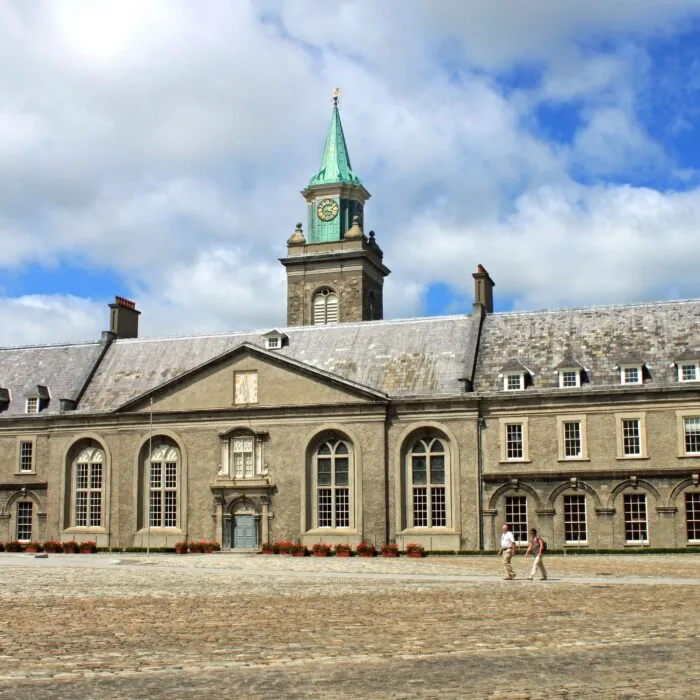
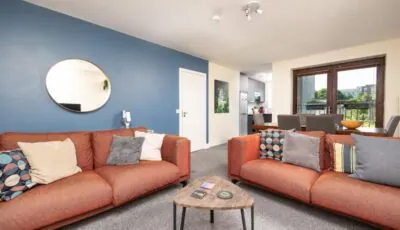
Want to extend your visit without having to rush around? Here are a few well-located places to stay near the must-see attractions.
Essential information to help you plan your visit, including key landmarks, access information, and booking options.
Inchicore Rd, Kilmainham, Kilmainham
53.342056, -6.309861
1 heure
Kilmainham Gaol Museum is open all year round, except on 24, 25, 26 and 27 December.
The prison can only be accessed as part of a pre-booked guided tour. Visitors are asked to arrive at least 15 minutes before the time shown on their ticket. Tickets go on sale 28 days before the visit date, at midnight Irish time. A small number of additional or cancelled tickets may be available on the day from around 9.15 am.
The guided tour lasts around one hour. Allow an additional 30 to 45 minutes to explore the museum, making a total visit time of around 1 hour 30 minutes.
Opening times may change during an event. It is essential to check the official Plan a Visit page.
Online booking is essential, including for children entitled to free admission and Heritage Card holders.
Tickets are non-transferable and generally non-refundable. Kilmainham Gaol does not authorise any third-party platforms to sell admission tickets. Tickets purchased from resellers do not grant access to the site.
Prices may change. Book only through Heritage Ireland or the official Kilmainham Gaol Museum website.
Compare tickets, guided tours, and excursions available through our partner platforms.