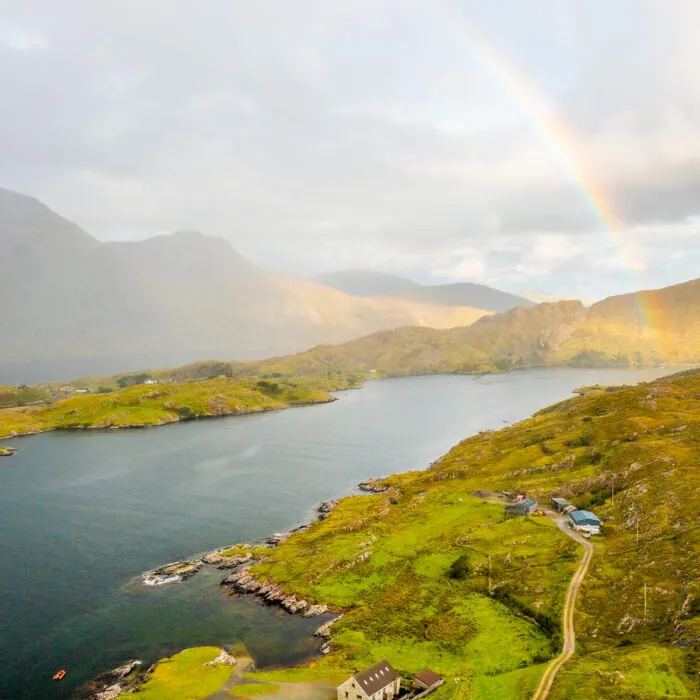


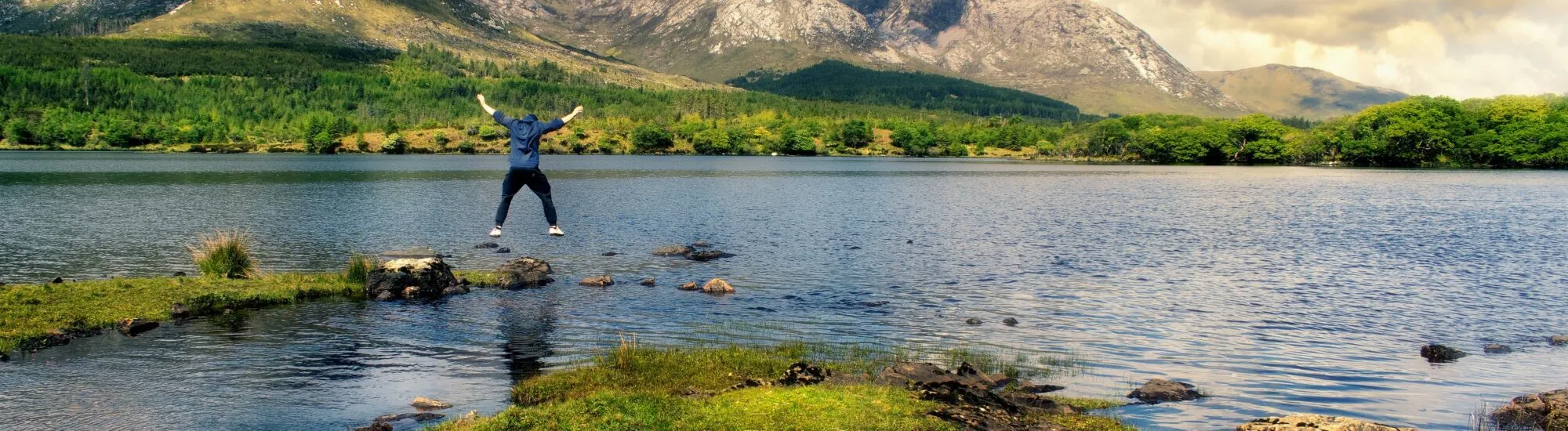
In the heart of Connemara, Lough Inagh stretches its dark waters between bogland, pasture and the mountains of western Ireland. This wild lake offers one of County Galway’s most striking landscapes.
Located around 23 km east of Clifden, Lough Inagh can be discovered along the scenic R344. Its official Irish name, Loch Eidhneach, reflects the Gaelic identity that remains deeply rooted in this part of the country.
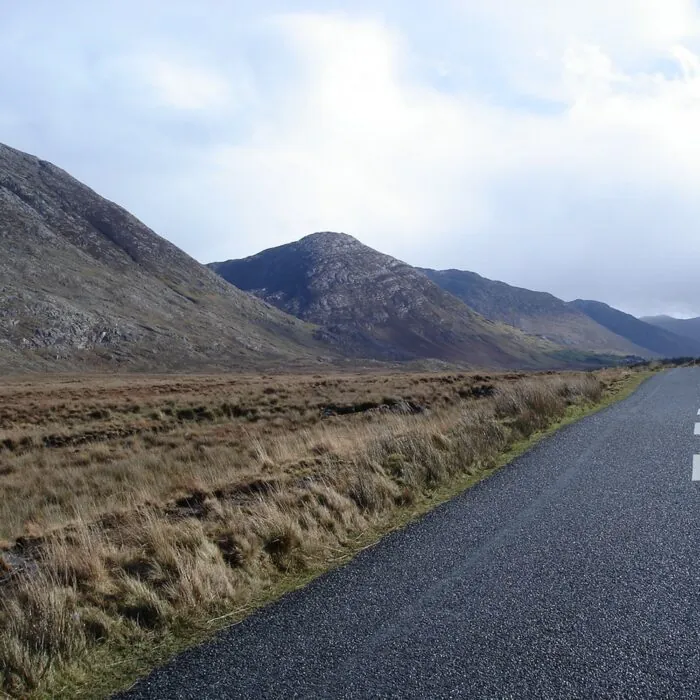
Lough Inagh lies at the heart of the Inagh Valley, a secluded valley dominated by the Twelve Bens to the west and the Maumturks to the east. When clouds cling to the summits and the mountains are reflected in the water, the landscape takes on the quality of a painting.
The lake is not a fenced-off tourist attraction. There is no general admission ticket or developed trail around its shores. The simplest way to admire it is to follow the R344 and take in the views as they gradually open out across the valley.
Fishing rights and some of the land bordering the lake are privately owned. Visitors must respect fences, signs and farming activity, and should not attempt to reach the shores by crossing pastureland. Any stops by car should likewise be made only in authorised, suitably safe places.
Lough Inagh is a glacial lake fed by water flowing down from the surrounding hills. It is linked to Derryclare Lough by a short watercourse. The two lakes form part of the same river system, which then continues towards Ballynahinch and the Atlantic coast.
Its shores alternate between bogland, wet grassland and rocky outcrops. Several small islands also dot its surface. The lack of significant development heightens the sense of isolation that defines the Inagh Valley.
The scenery changes constantly with the light. In sunshine, the mountains are reflected in the lake’s calm waters. When rain and wind arrive, the landscape becomes darker and more dramatic. These rapid shifts in atmosphere are an integral part of the experience.
The R344 is one of Connemara’s finest driving routes. It crosses the valley between the Twelve Bens and the Maumturks, passing close to Derryclare Lough and Lough Inagh. Allow between one and two hours to explore the valley at an unhurried pace and make several stops.
Photographers will particularly appreciate the start and end of the day, when the light brings out the contours and colours of the moorland. Breaks in the weather after a shower often create magnificent contrasts across the mountains.
A section of the Connemara Way, also known as the Western Way, crosses the Inagh Valley. However, it is a long-distance route rather than a developed loop around the lake.
There is no short, waymarked public path allowing visitors to walk freely around Lough Inagh. Walkers must remain on authorised paths, respect private property and bring waterproof footwear. The ground can be very wet, including in summer. Dogs are not permitted on the Western Way.
Lough Inagh is known for salmon, sea trout and wild brown trout. The fishery is operated by Lough Inagh Lodge, and fishing rights are not freely available. A local permit and advance booking are compulsory, including for fishing from authorised banks.
Fishing is exclusively by fly. Six boats are available on Lough Inagh, and specialist guides known as ghillies can accompany anglers by booking. The operator recommends using an outboard motor to navigate the lake.
Boating should never be undertaken without preparation. Wind, fog, water temperature and rapidly changing weather can make conditions difficult. Wearing a life jacket is essential.
In 2026, salmon and sea trout must be released. Only barbless single or double hooks are permitted, and worms are prohibited for all species.
A national licence is required to fish for salmon or sea trout. It does not replace the local permit issued by the fishery. Brown trout fishing does not require a national licence, but permission from the holder of the fishing rights remains compulsory.
Lough Inagh lies along the R344 in the Inagh Valley, near the village of Recess. From Clifden, allow around half an hour by car, depending on traffic conditions.
Twenty minutes may be enough for a simple photography stop. To also see Derryclare Lough and travel through the entire valley, allow one to two hours instead. A walk or a day’s fishing will naturally require more time.
The R344 is a narrow road, sometimes bordered by ditches and without a hard shoulder. Never stop on a bend or directly on the road to take a photograph. Sheep may also roam freely along certain stretches of the road.
As the weather is particularly changeable, bring waterproof clothing, even in summer. Mobile phone coverage can be patchy in the valley: download your route before setting off and let someone know if you are planning a walk.
Swimming and launching a personal boat should not be attempted without permission and detailed knowledge of the area. The water remains cold all year round, and there is no permanent lifeguard service.
South of the lake, Derryclare Lough and its famous wooded island form one of Connemara’s most photographed scenes. Experienced walkers can also head towards the Twelve Bens, whose summits dominate the entire western side of the valley.
Continuing north, the R344 joins the road to Kylemore Abbey and Leenane. To the south-west, Clifden makes an excellent base for exploring the coast and Connemara’s other natural sites.
Want to extend your visit without having to rush around? Here are a few well-located places to stay near the must-see attractions.
Essential information to help you plan your visit, including key landmarks, access information, and booking options.
sur la route R344, Connemara National Park, Connemara National Park
53.512879, -9.739365
45 minutes