

South of Phoenix Park, on a rise overlooking the Liffey Valley, an imposing fortress long remained off Dublin’s tourist trail. Yet behind its thick ramparts, Magazine Fort has witnessed almost three centuries of Irish history. A gunpowder store for the British Army, a target for insurgents during the 1916 Easter Rising, the setting for a spectacular IRA raid in 1939, and later an Irish Army installation, the site has an exceptional military past.
After several decades of highly restricted access, Magazine Fort is now open to the public through guided tours. The reopening follows a major restoration and safety programme carried out by the Office of Public Works (OPW). It is excellent news for history enthusiasts, as well as another reason to explore the lesser-known areas of Phoenix Park.
Magazine Fort is unlike Dublin’s traditional historical attractions. It is not yet a fully fitted-out museum with display cases, interpretation and interactive trails. For now, the site can be explored on a small-group guided tour, offering access to a military fortification whose history dates back to the 18th century.
This initial phase of opening offers a rather distinctive experience. Visitors discover the fort following its restoration, while taking in its military architecture, ramparts and the former buildings once used to store substantial quantities of gunpowder and ammunition.
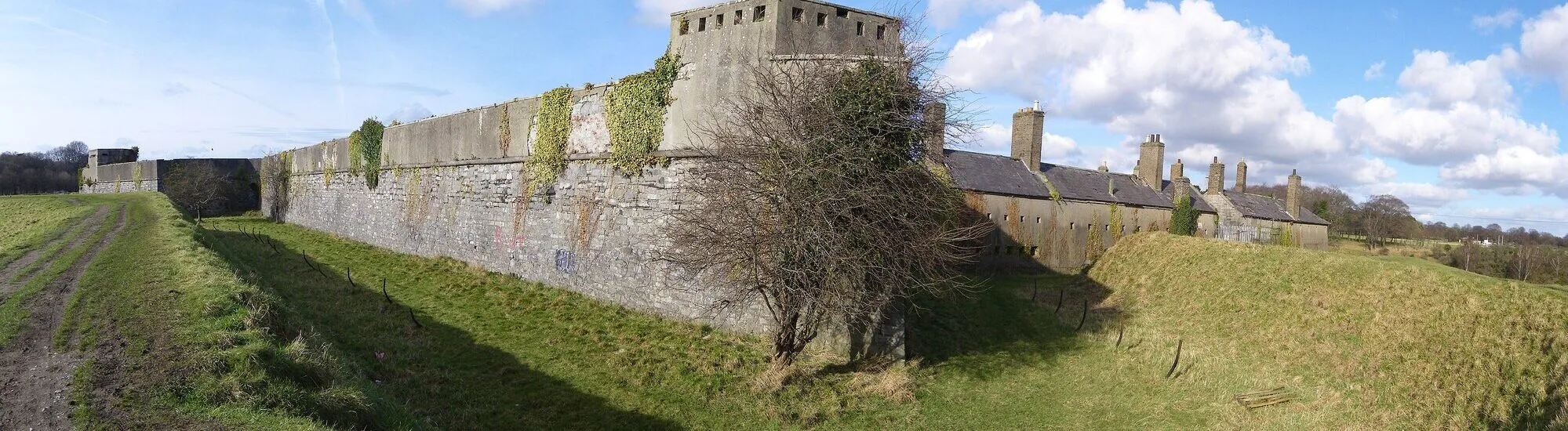
Magazine Fort occupies a strategic position on St Thomas Hill, not far from Phoenix Park’s Islandbridge Gate. From this height, the fortification once controlled an area overlooking the Liffey and afforded excellent views across the Dublin area.
The fort’s history begins in the 18th century. At the time, large reserves of gunpowder and ammunition were stored at Dublin Castle, in the heart of an increasingly populous city.
Such a concentration of explosive materials clearly posed a considerable risk. The authorities therefore decided to move these reserves to a more isolated location.
Between 1734 and 1736, a new fortification was built in Phoenix Park on the orders of the Duke of Dorset, then Lord Lieutenant of Ireland. The project was entrusted to Captain and military engineer John Corneille.
The result was a compact fortification characteristic of the military architecture of its period. The fort has a square plan, defended by four demi-bastions and surrounded by a dry moat. Inside were buildings designed to store gunpowder and ammunition.
Its name derives directly from its purpose: in military terminology, a “magazine” is a depot used, in particular, to store weapons, ammunition or gunpowder.
Magazine Fort retained a military role for more than two and a half centuries.
Between 1793 and 1801, several alterations strengthened its defences. In 1801, the architect Francis Johnston also oversaw an extension on the eastern side of the complex to provide accommodation for officers, soldiers and their families.
Throughout the British period, the fortress was a strategic site for Dublin’s military supply. It remained under British Army control until the establishment of the Irish Free State.
In 1922, Irish forces took possession of the site in turn. Magazine Fort then continued to be used for military purposes for several decades.
It was not until 1988 that the complex was finally transferred to the Office of Public Works, the public body responsible, among other things, for conserving part of the Irish State’s historic heritage.
Magazine Fort also occupies a striking place in the history of the 1916 Easter Rising.
On Monday 24 April 1916, as insurgents took up positions in several strategic buildings across Dublin, members of the Irish Volunteers and Na Fianna Éireann carried out an operation against the fort.
The aim was, in particular, to neutralise the site and prevent British forces from immediately using some of their military resources against the insurgents.
The operation at Magazine Fort was thus among the actions undertaken at the beginning of the Easter Rising, on the very day Patrick Pearse proclaimed the Irish Republic outside Dublin’s General Post Office.
A visit to the fort now makes it possible to place this episode in its real setting and better understand the site’s strategic importance at the beginning of the 20th century.
But the Easter Rising was not the only turbulent episode in its history.
On 23 December 1939, Magazine Fort became the setting for a spectacular IRA operation that has gone down in history as the Christmas Raid.
Members of the organisation managed to enter the complex and seize a substantial quantity of ammunition belonging to the Irish Army.
The event prompted a major response from the authorities. Much of the stolen ammunition was eventually recovered during the subsequent search operations.
Material traces of this long military history also resurfaced during the recent works. Archaeologists monitoring the site uncovered, among other things, grenade fragments, detonator components and a uniform button from the Irish Republican Brotherhood.
After decades of military use followed by a long period of restricted access, the condition of Magazine Fort called for major intervention.
The Office of Public Works therefore embarked on an extensive stabilisation and conservation programme. The work covered around 430 metres of historic ramparts, as well as the former powder magazines and various structures within the complex.
Craftspeople used traditional masonry and restoration techniques, particularly to repair the walls and preserve historic materials as far as possible.
One of the most visible interventions concerns the striking Duke of Dorset Gate. This monumental gateway was dismantled by the Irish Army in the 1970s to make it easier for vehicles to pass through. It was rebuilt as part of the project and once again marks the entrance to the fort.
The restoration also covered the three former vaulted buildings used to store gunpowder, the blast wall and other historic buildings.
The project occasionally led to unexpected discoveries.
During archaeological operations, the teams found what proved to be old, deteriorated explosive material in the ground.
The Irish Army Explosive Ordnance Disposal unit had to intervene to make these items safe and remove them.
The anecdote neatly illustrates Magazine Fort’s distinctive nature: even after several decades without a military role, the ground still bears tangible traces of its former use.
After more than two years of work, the first major phase of the conservation project enabled the official reopening of Magazine Fort to the public in July 2026.
Public investment at this stage amounts to around €5.7 million, including VAT. The work was also recognised in 2026 in several heritage conservation categories.
The reopening is nevertheless gradual. The Magazine Fort visitors see today is not yet the final version of the future visitor attraction.
Further phases are planned to improve visitor facilities, make more buildings accessible and develop the on-site amenities.
For now, Magazine Fort can be explored through guided tours organised by the Phoenix Park Guide Service.
Groups are particularly small: tours are limited to 12 people. This capacity allows visitors to explore the site in good conditions while respecting the constraints of a historic monument that is still being developed.
The tour covers the fort’s military history, its architecture, the major events with which it has been associated, and the techniques used during its restoration.
Bear in mind that part of the tour takes place outdoors. The OPW therefore recommends bringing clothing suitable for Irish weather and sufficiently sturdy footwear.
Advance booking is essential. As the number of visitors admitted on each tour is very limited, it is best to plan ahead when new dates are announced.
Most travellers associate Phoenix Park with its vast lawns, deer, Dublin Zoo and Áras an Uachtaráin, the official residence of the Irish President.
Magazine Fort reveals an entirely different side of it.
Its military architecture contrasts with the park’s open landscapes and tells of a time when Phoenix Park also held a strategic position in Dublin’s military network.
The visit is particularly interesting for travellers with a passion for Irish history. It perfectly complements a visit to the GPO, Kilmainham Gaol, Arbour Hill or the nearby Irish National War Memorial Gardens.
The site should become even more interesting in the coming years. New conservation phases are planned, and a project to create a link with the Irish National War Memorial Gardens is expected to help integrate this part of Phoenix Park more fully into Dublin sightseeing routes.
After centuries as a place designed to keep people at a distance, Magazine Fort is beginning a new life: that of a monument intended to tell visitors nearly three hundred years of Irish military history.
Want to extend your visit without having to rush around? Here are a few well-located places to stay near the must-see attractions.
Essential information to help you plan your visit, including key landmarks, access information, and booking options.
Phoenix Park, St Thomas Hill, Dublin, County Dublin, Republic of Ireland, Tourist sites in Ireland
53.3450, -6.3165
The OPW lists guided tours at 11 am, by reservation. Please note: slots are offered in periods and availability changes. You should therefore check which dates are actually open for booking before your visit. Phoenix Park itself remains accessible 24 hours a day, but this does not mean that Magazine Fort is freely accessible 24 hours a day.
Check the opening hours and admission requirements before you leave, especially during peak season or on Irish public holidays.
The tours currently offered by the OPW are free, but advance booking is required. Groups are strictly limited to 12 participants.