Celtic creatures in the streets of Derry, fire processions in Trim, fantastical tales at Howth Castle and the awakening of the Cailleach in Kilkenny: Halloween 2026 is set to be particularly lively in Ireland. From 28 October to 1 November, the two major festivals, Púca and Derry Halloween, will be joined by events across seven regions of the island. Here are the dates already confirmed and the first official programme details.
Why celebrate Halloween in Ireland?
A modern celebration inherited from the ancient festival of Samhain
Grinning pumpkins, macabre costumes and haunted houses may now seem part of American popular culture. Yet Halloween’s roots lie largely in Ireland’s ancient traditions.
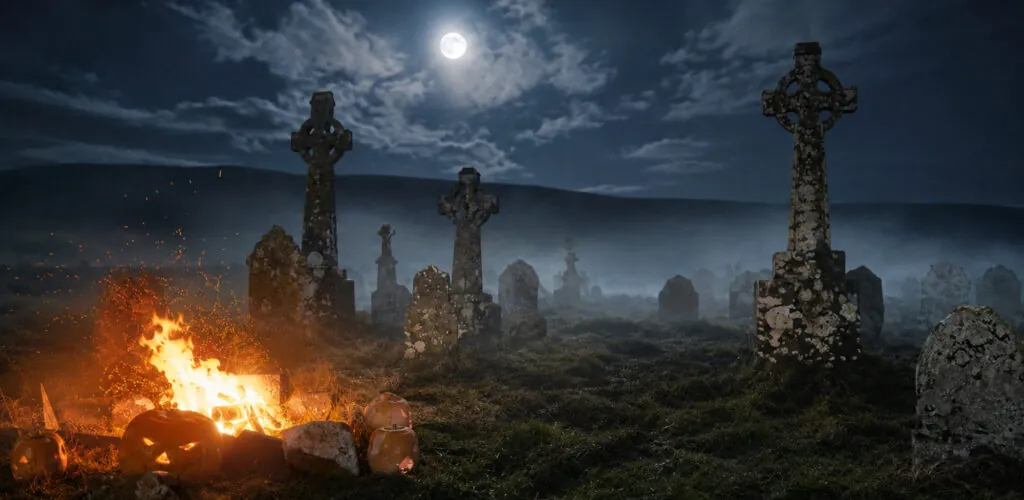
More than 2,000 years ago, Celtic communities celebrated Samhain at the end of the harvest season. This period marked the beginning of the darker half of the year, between late October and early November.
According to traditions handed down through texts and folklore, the boundary between the world of the living and the Otherworld became more fragile at this time. Spirits, ancestors and various supernatural beings could move among humans. Fires, gatherings, feasts and costumes all formed part of the celebrations.
These practices changed over the centuries, notably under the influence of Christianity, All Saints’ Day and Irish communities who emigrated to North America. Modern Halloween is therefore not an exact reproduction of a Celtic ritual, but several of its elements do indeed refer back to Samhain traditions.
Ireland now draws on this heritage to develop a genuine autumn tourism season, presented under the name Ireland, Home of Halloween.
What is the programme for Halloween 2026 in Ireland?
Two major festivals and seven destinations across the island
The national Halloween 2026 programme was officially launched on 21 July at the Hill of Uisneach in County Westmeath. This major ceremonial site is closely associated with the ancient traditions of Samhain.
The 2026 edition will centre on two main events: the Púca Festival in County Meath and Derry Halloween in Northern Ireland.
Seven regional hubs will complement the programme in Fingal, Galway, Kerry, Kilkenny, Limerick, Longford and Westmeath, as well as in the counties of Meath and Louth. The programme is set to bring together outdoor performances, processions, night trails, traditional storytelling, food experiences and family activities.
Not all local activities and their exact timings had been published at the time of the announcement. Visitors should therefore keep an eye on the relevant festival and tourism office websites before booking.
Púca Festival 2026 in Trim and Athboy
From 29 October to 1 November in County Meath
The Púca Festival will take place from Thursday 29 October to Sunday 1 November 2026 in Trim and Athboy. For four evenings, the two County Meath towns will be transformed into territories suspended ‘between worlds’, the theme chosen for this new edition.
The festival takes its name from the púca, a shapeshifting creature from Irish folklore. This unpredictable spirit can take many forms, including those of a horse, a dog or a human being. Encountering one can foretell either good fortune or trouble: exactly the sort of companion one would rather meet at a festival than on a remote road.
The programme will combine Irish mythology, music, comedy, street arts, storytelling, fire performances and food. Several signature events will return, including the lighting of the Samhain fire in Athboy and the Púca Procession in Trim.
The lighting of the Samhain fire in Athboy
A ceremony inspired by the gatherings at Tlachtga
Athboy lies close to the Hill of Ward, also known as Tlachtga. This archaeological site in County Meath is associated in Irish tradition with one of the great Samhain gatherings.
The Púca Festival draws on this heritage to present a contemporary fire-centred ceremony. Music, storytelling, mythological characters and visual performances symbolically accompany the passage from light into the dark season.
This is not an exact reconstruction of an ancient ritual whose every detail is known. The event offers a contemporary artistic interpretation of traditions documented through archaeology, medieval texts and folklore.
The Púca Procession through the streets of Trim
Fantastical creatures and fire performances around the castle
Trim will provide the festival’s other main stage. Its medieval fortress, Ireland’s largest Anglo-Norman fortress, makes a particularly striking setting as night falls over the Boyne Valley.
The Púca Procession will bring creatures inspired by Irish mythology through the town. Performers, musicians, giant animated figures and lighting effects will combine in a public spectacle.
The festival also plans a Púca Trail, a Samhain circus, storytelling gatherings, heritage tours and a harvest market announced as larger than in previous editions.
Some street entertainment will be freely accessible, while concerts, shows and experiences held indoors will require a ticket.
Concerts and shows at the Púca Festival 2026
A programme combining Irish music and comedy
Several artists have already been announced for the 2026 edition. The music line-up is set to include The Coronas, Glen Hansard, Róisín O, Hothouse Flowers, Jerry Fish, Qween and the Dublin Gospel Choir.
The comedy programme will include shows by John Colleary and Shane Daniel Byrne. Further artists and events may still be added.
In Athboy, the Samhain Banquet will offer a four-course dinner accompanied by Irish music and dance. This experience is for over-18s only. The announced price is €85, excluding booking fees.
Tickets for concerts, shows and experiences can be purchased separately on the official Púca Festival website. Booking promptly is recommended for events held in the smaller venues.
Derry Halloween celebrates its 40th anniversary in 2026
From 28 to 31 October in the walled city
Derry Halloween will take place from Wednesday 28 to Saturday 31 October 2026. This edition will mark the fortieth anniversary of a festival that has become one of Europe’s largest Halloween celebrations.
The event’s story began in 1986, when a few regulars at a Derry pub organised a fancy-dress party despite the tensions prevailing in Northern Ireland at the time. The celebration gradually grew until it took over the city walls, the streets of the historic centre and the banks of the Foyle.
The festival now draws more than 100,000 people, according to its organisers. For four days, residents and visitors dress as fantastical creatures, witches, ghosts or characters much harder to identify after dark.
The fortieth-anniversary programme is set to include aerial shows, acrobatics, street theatre, music, light installations, pyrotechnics and children’s activities.
Awakening the Walled City
A night-time trail along Derry’s walls
The Awakening the Walled City trail is one of the highlights of Derry Halloween. Over several evenings, the old walls and streets of the historic centre become the setting for a journey populated by strange characters.
The route usually passes through Guildhall Square, Shipquay Street, the Diamond, Bishop Street and the Cathedral Quarter. Illuminations, music, theatre, acrobatics and pyrotechnic effects bring to life a ‘city of bones’ where the spirits of Samhain seem to reclaim the place.
The trail is designed to welcome families, although some creatures or atmospheres may be unsettling for younger children. Access to the main outdoor installations is generally free.
Detailed timings for the 2026 edition are still to be confirmed on the official Derry Halloween website.
Derry’s grand Halloween parade
A spectacular finale on 31 October
The evening of 31 October will feature Derry’s grand carnival parade. Arts groups, associations, musicians and costumed residents will parade through the city centre with floats and creatures inspired by Samhain folklore.
A fireworks display is set to bring the celebrations to a close. Its exact timing and whether it goes ahead will depend in particular on weather conditions.
The parade and fireworks are advertised as free. Some concerts, guided tours or additional events may, however, require booking or a ticket.
Given the expected crowds for the fortieth anniversary, booking accommodation several months in advance is strongly advised. Properties near the city walls, Guildhall Square and the Peace Bridge are best placed for enjoying the festivities, but are also the first to sell out.
New permanent experiences in Derry
Halloween should no longer be confined to October
The 2026 programme is also set to mark the launch of new experiences available beyond the festival period.
A Derry Samhain Experience has been announced to tell the story of the links between the city, folklore and the origins of Halloween. A permanent mural dedicated to Derry Halloween is also due to be created.
Full visitor arrangements and opening dates have not yet all been announced. Nevertheless, these additions show the intention to make Halloween a lasting part of Derry’s tourism identity.
Halloween 2026 in Kilkenny
Macnas’s Cailleach will take over the medieval city
In 2026, Kilkenny will host a major new outdoor show. The programme will include The Cailleach, a creation by Irish company Macnas.
In Gaelic mythology and folklore, the Cailleach is a powerful female figure associated with winter, wild landscapes and the changing of the seasons. She sometimes appears as a divine old woman able to shape mountains and command the elements.
Macnas is known for its monumental processions, giant puppets and visual theatre. The meeting of this company and Kilkenny’s medieval streets should be one of the season’s major new features.
The date, route and access arrangements for the show are still to be detailed by local organisers.
Halloween 2026 in Fingal and Howth
Howth Castle joins the celebrations
The Fingal hub will strengthen its programme around heritage, folklore and the sharing of local stories. Events will extend in particular to Howth Castle, which has so far rarely been associated with major Halloween celebrations.
Storytelling and culinary experiences have already been announced. The Howth Castle Cookery School will offer workshops inspired by the Samhain banquet on 28 and 30 October, as well as a seasonal brunch on 1 November.
These classes are ticketed and must be booked in advance. Other activities planned within the castle grounds will be specified later.
Howth is an appealing option for travellers staying in Dublin. The peninsula is easily reached by DART train from the capital’s centre, making it possible to combine the festivities with a coastal walk or a visit to the harbour.
Halloween in Longford and Westmeath
A Samhain trail through ancient landscapes
The counties of Longford and Westmeath will present a joint programme in Ireland’s Hidden Heartlands. Celebrations will draw on the region’s bogs, ancient pathways, ceremonial sites and rich mythological heritage.
Among the announced new additions is the Spooktacular Summoning at Dún na Sí Amenity and Heritage Park, near Moate. A new Samhain trail is also set to link several historic and natural sites.
Athlone will host a new procession. Its timings and route will be announced when the full local programme is published.
The Hill of Uisneach is expected once again to play a central role. Regarded in tradition as Ireland’s sacred centre, it once hosted major seasonal gatherings. Modern celebrations there generally combine storytelling, music, fire and landscape discovery.
In Longford, the Dead of Night festival traditionally stages a procession of fire and shadows. The regional programme also extends to the Corlea Trackway Visitor Centre, where an Iron Age wooden road is preserved amid the bogs.
Halloween 2026 in Limerick
A Samhain banquet and events across the region
Limerick will develop its programme between 11 October and 1 November 2026. Funding of €130,000 has been made available to cultural groups, associations and tourism businesses to create events across the city and county.
The main new addition announced is a Samhain banquet dedicated to local food, seasonal traditions and regional culture.
The menu, venue, price and exact date of the banquet have not yet been made public. Other community and artistic events are set to complete the programme throughout the county.
Halloween in Galway and Kerry
Regional programmes still in preparation
Galway and Kerry will be among the seven official Ireland, Home of Halloween destinations in 2026. Fáilte Ireland has announced festivals, performances, trails, food experiences and Samhain-inspired celebrations.
At the end of July, however, their detailed programmes had not yet been published. It would therefore be premature to provide dates, venues or prices that have not been officially confirmed.
Information is expected to be released gradually by tourism offices and local authorities. Interested travellers would do well to follow the listings from Visit Galway, Discover Kerry and Discover Ireland.
The Meath and Louth programme
The Boyne Valley at the heart of Halloween’s origins
In addition to the Púca Festival in Trim and Athboy, the counties of Meath and Louth will host several activities linked to the folklore, heritage and ancient landscapes of the Boyne Valley.
This region has a remarkable concentration of prehistoric and medieval sites. The Hill of Ward, Tara, Trim Castle and the monuments of Brú na Bóinne place the celebrations in a history far older than modern pumpkins and costumes.
Details of events held outside the Púca Festival remain incomplete. Some experiences may require a separate ticket, particularly guided tours and performances staged indoors.
Should you choose Púca or Derry Halloween?
Two very different atmospheres
Derry Halloween is especially suited to travellers looking for a huge, free and spectacular public celebration. The city walls, thousands of costumed people, parade and fireworks create a distinctly urban atmosphere. The whole city seems to take part in the event.
The Púca Festival offers a more dispersed experience, centred on myths, music and County Meath’s historic sites. Free processions sit alongside ticketed concerts, shows and experiences. A car may be useful for travelling between Trim, Athboy and other sites in the region.
The dates theoretically allow visitors to combine the two festivals: Derry Halloween begins on 28 October, while Púca ends on 1 November. However, the journey between Derry and Trim takes several hours and needs to be planned ahead.
How to prepare for a Halloween trip to Ireland
Book early and prepare for very Irish weather
The Halloween period draws many visitors, particularly to Derry, Trim and Athboy. For the weekend of 31 October, it is best to book accommodation several months in advance.
In Derry, staying in the centre makes it possible to reach the city walls and parade on foot. In Trim, staying near the castle makes it easier to access the main events. Athboy has more limited accommodation, so it may be necessary to look for somewhere to stay nearby.
Late October weather is cool, wet and changeable. A waterproof jacket, suitable footwear and several layers are essential, especially for processions and evening performances.
Finally, timings and routes may change because of wind or rain, particularly for fireworks and pyrotechnic performances. Checking the official websites a few hours before each event remains the best precaution.
A Halloween season that has become strategic for Ireland
More than 322,000 visitors at the previous edition
The national programme is not driven by cultural aims alone. It is also intended to extend the tourism season beyond summer and encourage travellers to discover less-visited areas.
According to Fáilte Ireland, the Ireland, Home of Halloween initiative supported more than 830 events in 2025. They are said to have attracted more than 322,000 Irish and international visitors, generating an estimated economic impact of more than €43 million.
The 2026 edition therefore aims to turn Halloween into a true travel season. The major celebrations in Derry and County Meath are now joined by experiences spread across a large part of the island.
A skilful way to recall that before illuminated pumpkins and horror films, Halloween was first an Irish story of fire, changing seasons and doors left ajar between two worlds.