Travelling to Ireland in September means enjoying a country that is still vibrant after the summer, yet already more peaceful. The days remain long enough to explore the great outdoors, temperatures are generally mild, the main tourist sites are still operating at full capacity, and the landscapes are gradually beginning to take on their autumn colours. Add several major festivals, fewer visitors than in July and August, and that distinctive late-summer light, and September has a strong case for becoming one of the best months to discover Ireland.
Why visit Ireland in September?
The right balance between summer and autumn
September occupies a somewhat distinctive place in the Irish calendar. The bustle of the summer holidays is beginning to ease, but autumn has not yet truly set in. For travellers, this in-between period often offers an excellent balance.
The main tourist sites remain open, the days still allow for long excursions, and temperatures remain relatively mild. At the same time, some destinations that are particularly busy at the height of summer gradually regain a quieter atmosphere.
This is particularly welcome in Killarney, Dingle, Galway, Connemara and the Ring of Kerry, where traffic and visitor numbers can be high in the heart of summer.
However, September should not be imagined as a miraculously dry month. In Ireland, rain can arrive at any time of year and the weather remains changeable. September’s appeal lies more in its overall balance than in any guarantee of sunshine.
What is the weather like in Ireland in September?
Temperatures are still mild, but the weather is highly variable
September generally retains some of the mildness inherited from summer. Met Éireann’s 1991–2020 climate normals show average maximum temperatures of around 16 to 17.5°C in several parts of the country.
At Dublin Airport, the average daily maximum in September is around 16.9°C, with an average minimum of 9.5°C. In Shannon, in the west, average maximums reach around 17.5°C. On the Kerry coast, at Valentia, they are close to 16.9°C.
Days above 18 or 20°C are therefore still possible, particularly during high-pressure spells. Conversely, an Atlantic weather system can bring rain, wind and markedly cooler temperatures.
That is the challenge of Irish weather: a single day can alternate between blue skies, showers and spectacular sunny spells. In September, it is therefore best to think in terms of adaptability rather than seek a perfect forecast several weeks in advance.
Does it rain a lot in Ireland in September?
Rain remains possible everywhere, especially along the Atlantic coast
Yes, you should expect rain. But that does not necessarily mean whole days under grey skies.
Irish rainfall often comes in the form of showers, with sunny spells appearing in between. Conditions also vary greatly by region: west-facing Atlantic coasts are generally wetter than the east of the country.
Kerry, Connemara, Mayo and Donegal can receive weather systems directly from the ocean, while Dublin and the east coast regularly benefit from drier conditions.
There is no absolute rule, however. One September can be relatively calm and bright, while the next may be far wetter. When planning a road trip, it is therefore best to keep some flexibility in your itinerary.
Are the days still long enough in September?
Yes, especially during the first half of the month
This is one of the major advantages of travelling in September compared with later in the autumn.
In Dublin, on 1 September 2026, the sun will rise at around 6.34am and set at around 8.14pm, giving approximately 13 hours and 40 minutes of daylight.
By the end of the month, the difference becomes clearly noticeable. On 30 September, the sun will rise at around 7.24am and set at around 7.04pm, still leaving approximately 11 hours and 40 minutes of daylight.
For a road trip, the beginning of the month therefore offers a significant advantage. It is still possible to combine a hike, a visit and several scenic stops without feeling as though you are racing against nightfall.
September helps you avoid some of the summer crowds
The great landscapes gradually become quieter again
July and August are the height of Ireland’s tourist season. September gradually marks a return to a calmer pace, particularly after schools reopen.
The difference can be welcome at the busiest sites: the Cliffs of Moher, Killarney National Park, the Dingle Peninsula, Giant’s Causeway, Connemara and the main stops along the Ring of Kerry.
That does not mean you will have the cliffs to yourself. Ireland remains a major tourist destination, and some sites attract large numbers of visitors throughout the year. But the experience generally becomes more pleasant than at the peak of the summer holidays.
This gradual drop in visitor numbers is also of interest to photographers. Arriving early in the morning or late in the day makes it easier to enjoy certain views in a peaceful atmosphere.
Is accommodation cheaper in September?
A period that can be more attractive after the summer peak
September can offer greater availability and, depending on the destination, more attractive rates than in the height of August.
That should not, however, be seen as an absolute rule. Dublin remains expensive for much of the year, and a festival, concert or sporting event can quickly push up room prices in a city.
In highly touristy areas such as Killarney, Galway or Dingle, booking in advance remains strongly recommended, particularly for Friday and Saturday nights.
The difference is felt more from mid-September, when the European summer holidays have truly come to an end.
Irish landscapes begin to change
Light and colours different from those of summer
September also offers another way to photograph Ireland.
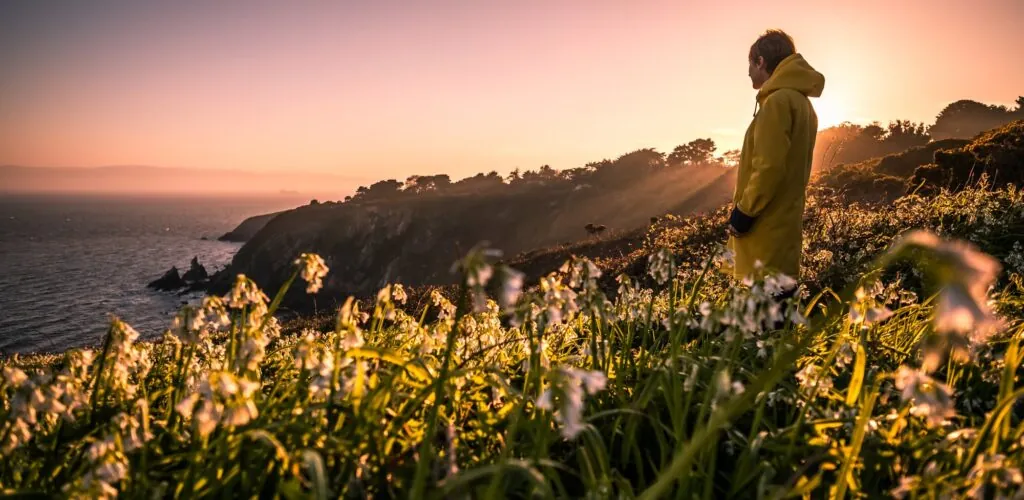
The landscapes remain largely green, but the first autumnal shades begin to appear in the forests, ferns and some heathland. The light also gradually lowers on the horizon, sometimes giving more definition to mountains and cliffs.
In places such as Glendalough, Killarney National Park, the Wicklow Mountains and Glenveagh National Park, the transition into autumn can be particularly beautiful.
Along the Wild Atlantic Way, changing light and showers also create those typically Irish contrasts: one hillside shrouded in shadow while a sunny spell suddenly lights up the ocean a few kilometres away.
September is an excellent month for hiking in Ireland
Pleasant temperatures for walking
September’s generally moderate temperatures are very well suited to hiking. It is rarely too hot, and the days remain long enough for routes lasting several hours.
The month is particularly appealing for exploring Diamond Hill in Connemara, the Wicklow Mountains, the Twelve Bens, the Kerry mountains and Donegal’s coastal trails.
The weather nevertheless calls for a few precautions. In the Irish uplands, conditions can change very quickly. Fog, wind or rain can appear even when the sky was clear at the start.
For mountain hikes, always check local forecasts and bring waterproof clothing, even when the day begins in sunshine.
September 2026 will also feature several festivals
Culture, hiking, surfing and food on the programme
Travelling to Ireland in September does not mean discovering a country asleep after the summer. Several important events are still held across the island.
From 5 to 13 September 2026, the Saltwater Festival will bring life to the counties of Sligo and Donegal in particular. Held along the Wild Atlantic Way, the event celebrates surf culture and includes competitions, beach activities, local food, screenings and music.
From 12 to 20 September, the Boyne Valley Walking Festival will offer guided walks through the historic landscapes of the Boyne Valley, a region renowned for its prehistoric monuments and heritage.
In Connemara, the Clifden Arts Festival will take place from 17 to 27 September. The festival combines music, literature, theatre, visual arts and talks in one of the most charming small towns in western Ireland.
Finally, Galway will host its renowned International Oyster & Seafood Festival at the end of the month, an event particularly popular with lovers of seafood and festive atmospheres.
Early or late September: which period should you choose?
Two slightly different experiences
To make the most of the long days while retaining an atmosphere close to summer, the first half of September is probably the best compromise.
Visitor numbers have already begun to fall, days still comfortably exceed 12 hours, and seasonal activities generally operate as usual.
The second half of the month has its own charm, however. The atmosphere becomes more autumnal, sites can be even quieter, and several major cultural events take place.
In return, evenings draw in earlier and the weather can take on a more autumnal character.
Which places should you prioritise in Ireland in September?
The west for wide-open spaces, the east for greater weather flexibility
September works particularly well for a road trip along the Wild Atlantic Way. Connemara, the Burren, Kerry, West Cork and Donegal offer the chance to enjoy coastal landscapes after the peak summer crowds.
Killarney is also an excellent destination thanks to its combination of lakes, mountains, forests and the national park’s many heritage sites.
For a shorter stay, Dublin can be combined with the Wicklow Mountains and Glendalough. This option also has the advantage of limiting long car journeys.
Finally, Northern Ireland deserves several days, with Belfast, the Causeway Coastal Route, Giant’s Causeway and the Antrim coast.
What should you pack for Ireland in September?
The key is to layer up
Forget a suitcase made up entirely of summer clothes, but there is no need to arrive equipped as though it were January either.
The most practical approach is to wear several layers: a T-shirt, jumper or light fleece, and a properly waterproof, windproof jacket. This will allow you to adapt your outfit easily to changing temperatures.
Comfortable, water-resistant shoes are strongly recommended if you plan to hike or visit natural sites. A small waterproof backpack or a cover for your bag can also prove very useful.
Add a pair of sunglasses. It may seem optimistic when preparing for a trip to Ireland, but sunny spells can be particularly bright after a shower.
What are the downsides of travelling in September?
Weather that remains unpredictable and days that shorten quickly
September is not perfect. Its main drawback is, of course, the uncertainty of the weather. A beautiful week can be followed by a succession of Atlantic weather systems.
The days also shorten quickly: Dublin loses around two hours of daylight between the beginning and the end of the month.
Finally, some highly seasonal attractions gradually begin to reduce their opening hours as autumn approaches. This is particularly true of certain boat trips, small private attractions and activities dependent on sea conditions.
Before making an important journey, always check the official opening hours of the site concerned rather than relying solely on summer timetables.
So, is September really one of the best months to visit Ireland?
A period particularly well suited to road trips
For those who accept the unpredictable nature of Irish weather, September has almost all the ingredients for an excellent trip: still relatively mild temperatures, long days at the start of the month, fewer visitors and the vast majority of attractions still accessible.
It is above all an ideal period for travellers who like to alternate between scenic drives, hikes and cultural visits without facing the sometimes more intense pace of the summer holidays.
The best advice is never to build your itinerary around supposedly perfect weather. In Ireland, it is better to have several options for each day. If clouds cling to the mountains, use the opportunity to visit a castle, distillery or museum. When the sunny spell arrives, head back towards the ocean: in September even more than in summer, the finest moments sometimes appear between two showers.