
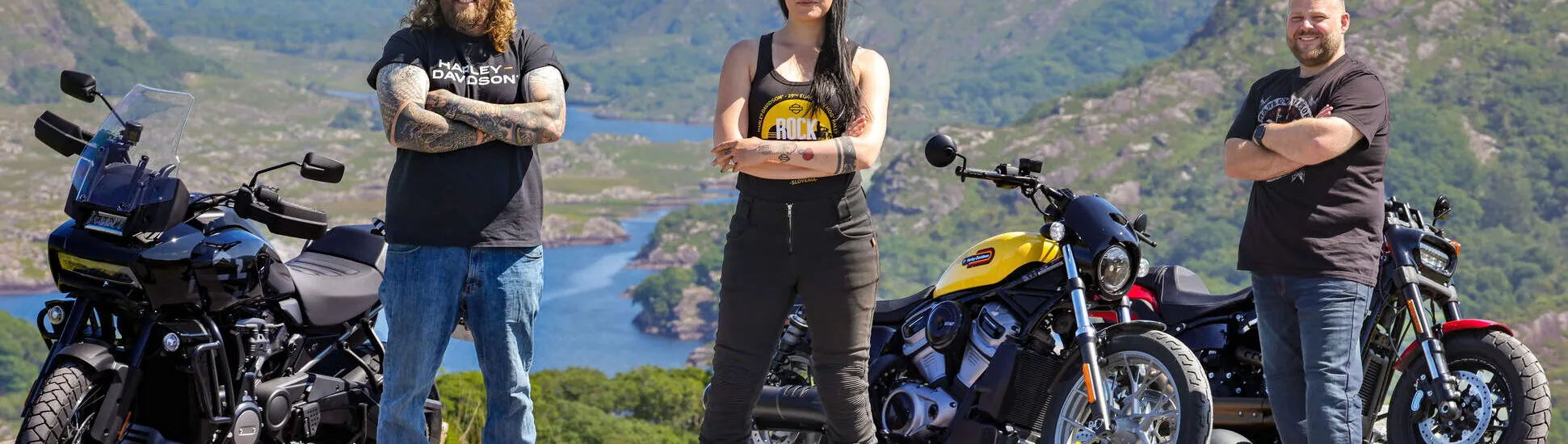
Exploring Ireland by motorbike means watching the landscape change with every bend: a road lined with stone walls, a beach appearing beyond a hill, a mountain pass shrouded in mist, or a village where you stop simply because it looks welcoming. With its manageable distances and varied scenery, the island is wonderfully suited to two-wheeled touring.
This freedom does, however, require a little preparation. Driving on the left, narrow roads, changeable weather and different regulations in Northern Ireland: it is best to understand the local particularities before setting off.
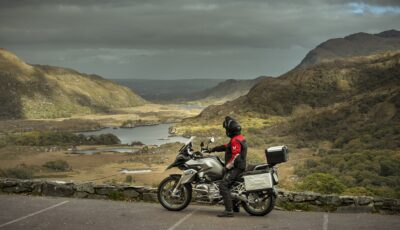
A motorcyclist in Ireland – George Karbu – CC
By motorbike, Ireland reveals itself less as a sequence of stops than as a landscape in motion. Minor roads wind between pastures, skirt silent bogs and sometimes run close to the cliffs. Distances may look short on a map, but the journey naturally takes its time.
The motorway network makes it easy to reach the main regions quickly. Yet it offers limited enjoyment from a riding perspective. The finest experiences are found on national, regional and local roads, provided you are happy to take things slowly and stop often.
A daily route of between 150 and 250 kilometres is generally enough to enjoy the scenery without turning the trip into an endurance test. On the west coast, 200 kilometres can easily take up a full day once breaks, visits and changes in the weather are factored in.
Bringing your own motorbike is often the preferred option for European travellers. It allows you to ride a machine you know, use your usual luggage and avoid the sometimes restrictive terms of hiring.
Ferry routes link France and Great Britain, among other places, with several Irish ports. Sailings and routes change with the seasons, so it is essential to check operators’ timetables before planning your road trip.
When boarding, motorbikes are placed on the vehicle deck and secured with straps. Securing equipment is generally provided and the crew may assist, but each operator has its own instructions. Remove anything that could fall off and prepare a small bag with what you need during the crossing, as the vehicle deck usually becomes inaccessible once the ship is at sea.
The ticket must include the passenger, the motorbike and, for overnight crossings, the chosen type of accommodation. A cabin adds to the cost, but allows you to disembark well rested before your first day of riding on the left.
Hiring avoids the ferry crossing and allows you to fly in with lighter equipment. However, the choice is considerably more limited than for cars. Booking several months in advance is recommended, especially between May and September.
Terms vary considerably between providers. Some hire companies require riders to be at least 20, while others set the minimum age at 25. A full motorbike licence for the relevant vehicle category, proof of identity, a bank card and a substantial deposit are generally required.
Before booking, compare the included mileage, excess amount, breakdown or puncture assistance, luggage, rain gear and cancellation terms. If the route crosses into Northern Ireland, this must be explicitly authorised by the hire company and covered by the insurance.
Some providers offer self-guided or escorted tours including the motorbike, accommodation, transfers and assistance. This option costs more than straightforward hire, but may reassure travellers experiencing left-hand driving for the first time.
A valid motorbike licence appropriate to the category of machine is compulsory. Full licences issued by a country in the European Union or European Economic Area are recognised in the Republic of Ireland. For licences issued elsewhere, requirements depend on the country of origin and an international driving permit may be needed.
National equivalences allowing a 125cc motorbike to be ridden with an ordinary car licence are not automatically recognised abroad. It is therefore safer to hold an A1, A2 or A category clearly stated on your licence and to seek confirmation from the hire company before making any payment.
If bringing your own motorbike, take the registration certificate, proof of insurance valid in the Republic of Ireland and, if necessary, Northern Ireland, as well as proof of ownership or authorisation to use the vehicle. Third-party insurance is compulsory, but cover for theft, damage, assistance and repatriation is far preferable for a touring trip.
A green card is not systematically required for vehicles insured in the European Union. Even so, it is advisable to ask your insurer for a certificate specifying the territories covered and to keep proof of insurance easily accessible.
There is no permanent road border checkpoint between the Republic of Ireland and Northern Ireland. You may cross without noticing, but doing so means entering a different legal jurisdiction.
Most European visitors must now obtain an electronic travel authorisation, or ETA, before entering the United Kingdom, including when travelling to Northern Ireland by road. This formality is linked to the passport used for the journey. Exemptions apply in particular to British and Irish citizens and, under certain conditions, legal residents of the Republic of Ireland.
In Northern Ireland, the currency is pound sterling and speed limits are expressed in miles per hour. Mobile phone usage terms may also change after crossing the border: it is best to check the roaming rules applied by your provider.
Traffic drives on the left in both the Republic of Ireland and Northern Ireland. Overtaking is done on the right, and roundabouts are approached clockwise, giving priority to vehicles already on them coming from the right.
The first few miles require particular attention, especially after a break, when leaving a petrol station or when setting off again on an empty road. These are often the moments when riders inadvertently return to the wrong side of the road.
Avoid riding too close to the left-hand edge, too. Verges may conceal gravel, potholes, mud or wet vegetation. On roads lined with hedges and walls, it is best to hold a position that keeps you visible without exposing you to vehicles coming around a bend.
In the Republic of Ireland, signs display speeds in kilometres per hour. Since February 2025, the default limit on many local rural roads has fallen from 80 to 60 km/h. Other roads may be limited to 80, 100 or 120 km/h depending on their category, but local signage always takes precedence.
In Northern Ireland, speeds are displayed in miles per hour. The most common limits are 30 mph in built-up areas, 60 mph outside built-up areas and 70 mph on motorways or certain dual carriageways, unless otherwise indicated.
A permitted limit is never a speed you are required to reach. On a narrow, wet road or one with limited visibility, you must be able to stop for a tractor, a flock of animals, a cyclist or a vehicle occupying part of the carriageway.
At around 2,500 kilometres long, the Wild Atlantic Way runs from the Inishowen Peninsula in Donegal to Kinsale in County Cork. It follows the Atlantic coast and crosses some of the island’s most spectacular landscapes.
Ideally, travelling the entire route takes two to three weeks. For a shorter stay, it is better to choose one or two regions rather than trying to string together every point of interest. Donegal, Mayo, Connemara, Clare, Kerry and west Cork can each fill several days.
The south-west brings together several routes popular with motorcyclists. The Ring of Kerry forms a loop of around 180 kilometres through mountains, lakes and ocean scenery. It can be ridden in a day, but deserves more time if you want to explore the Skellig Ring and the minor roads of the Iveragh Peninsula.
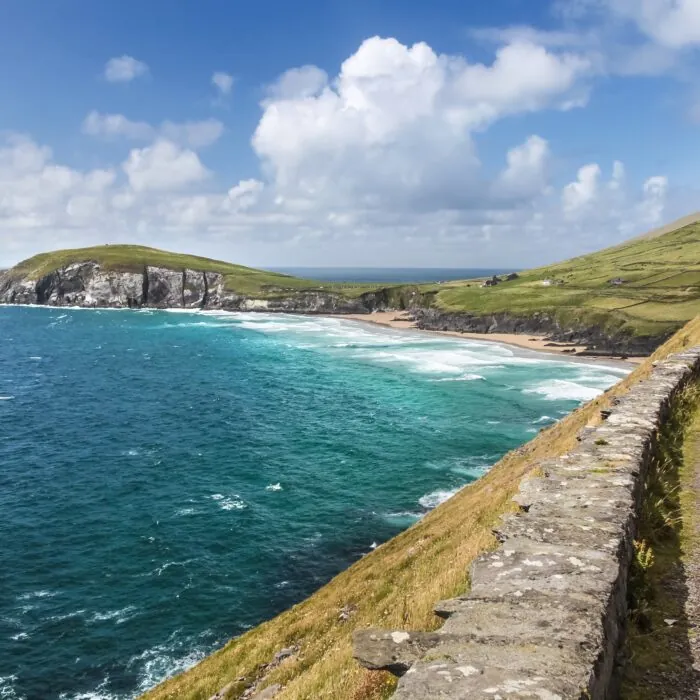
The Dingle Peninsula offers a more compact route, marked by the cliffs of Slea Head, beaches and the slopes of Mount Brandon. Further south, the Beara Peninsula has quieter, narrower roads that are often highly exposed to the wind.
Connemara alternates lakes, bogs, mountains and sea inlets. Roads around Clifden, the Inagh Valley and Killary Harbour make it possible to plan superb stages without clocking up the kilometres.
Further south, the Burren offers an entirely different setting. Its limestone plateau, stone walls and roads overlooking Galway Bay create an almost mineral atmosphere. The road surface can, however, become slippery in the rain.
The Causeway Coastal Route runs from Belfast to Derry-Londonderry along part of the northern coast. Depending on the detours taken, it covers around 120 to 185 kilometres.
The route serves Carrickfergus, the Glens of Antrim, Ballycastle, Ballintoy, the Giant’s Causeway and the area around Portrush, among other places. One day is enough to travel the main route, but two days allow you to properly enjoy the scenery and sights.
Rain does not always last long in Ireland, but it can arrive without warning. Wind is often a greater challenge, particularly on peninsulas, bridges and exposed coastal roads. A strong side gust can suddenly shift a loaded motorbike.
Road surfaces on main roads are generally satisfactory. Minor roads, on the other hand, may have potholes, uneven repairs, mud, wet leaves or gravel carried from a farm entrance. Blind bends are common, and some roads are barely wide enough for two vehicles.
You should also anticipate sheep, tractors, agricultural vehicles and tourist coaches. A seemingly empty road must never tempt you to cut a bend or ride beyond the distance you can see.
Wearing an approved and properly fastened helmet is compulsory for both rider and passenger. The Road Safety Authority also recommends riding with dipped headlights on, wearing visible clothing and using full protective gear.
A reinforced jacket and trousers, gloves, boots covering the ankles and suitable protection are essential. A waterproof membrane or readily accessible rain suit saves you from having to unpack your luggage when a shower arrives.
Temperatures can remain cool, even in summer. Several thin layers are often more effective than a single thick garment. Spare gloves, a neck warmer and an anti-fog solution for the visor greatly improve comfort on wet days.
In the most remote areas, it is wise to fill up before reaching reserve. Petrol stations remain plentiful around towns, but may be further apart on certain peninsulas and coastal roads.
Luggage should be waterproof, balanced and securely fastened. Heavy items are best placed as low as possible. At every stop, it is useful to check straps, panniers and anything that could move in the wind.
When booking accommodation, the availability of private parking or parking visible from the property is a real advantage. An additional lock is still recommended, as is leaving no valuables on the motorbike.
For group travel, it is best to keep the number of motorbikes limited and agree meeting points before departure. A staggered formation improves visibility. Every rider should travel at their own pace, without exceeding their limits to keep up with the group.
A free day in the itinerary allows for bad weather, unexpected fatigue or a change to a ferry crossing. In an emergency, 112 and 999 work in both the Republic of Ireland and Northern Ireland.
Safety rules and equipment recommendations are available from the Road Safety Authority. Requirements for foreign licences are detailed by Citizens Information and the official nidirect portal. Travellers planning to visit Northern Ireland should also check the rules relating to the UK electronic travel authorisation.