County Galway brings together some of the most iconic landscapes in western Ireland. From the lively streets of Galway city to the mountains of Connemara, its territory unfolds among lakes, bogs, beaches and rocky coastlines open to the Atlantic Ocean.
Ireland’s second-largest county by area, Galway covers approximately 6,150 km². It encompasses a remarkably diverse region: Connemara to the west, the Aran Islands in Galway Bay, Lough Corrib north of the city, and gentler countryside around Athenry, Loughrea and Portumna.
Visiting County Galway
A region between culture, mountains and ocean
County Galway, Contae na Gaillimhe in Irish, belongs to the province of Connacht. It had a population of 277,737 in 2022, including Galway city, according to the Irish Central Statistics Office.
Administratively, Galway city and the rest of the county are managed by two separate local authorities. This division does not prevent the city from serving as the main gateway to Connemara, the Aran Islands and the entire western coast.
The Wild Atlantic Way crosses a large part of the county. It serves coastal villages, beaches, harbours and several major natural sites. Inland, the landscape is dominated by the mountains, bogs and countless lakes of Connemara.
Discovering Galway city
A cultural capital facing the Atlantic
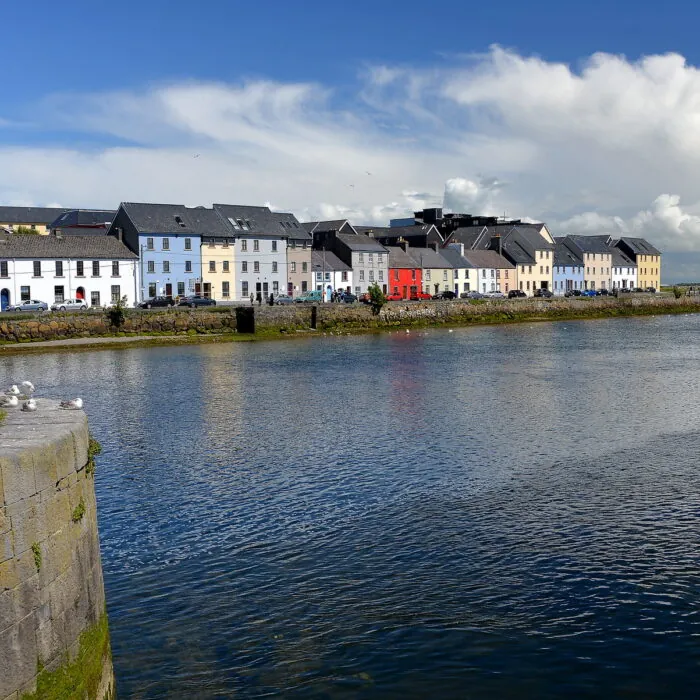
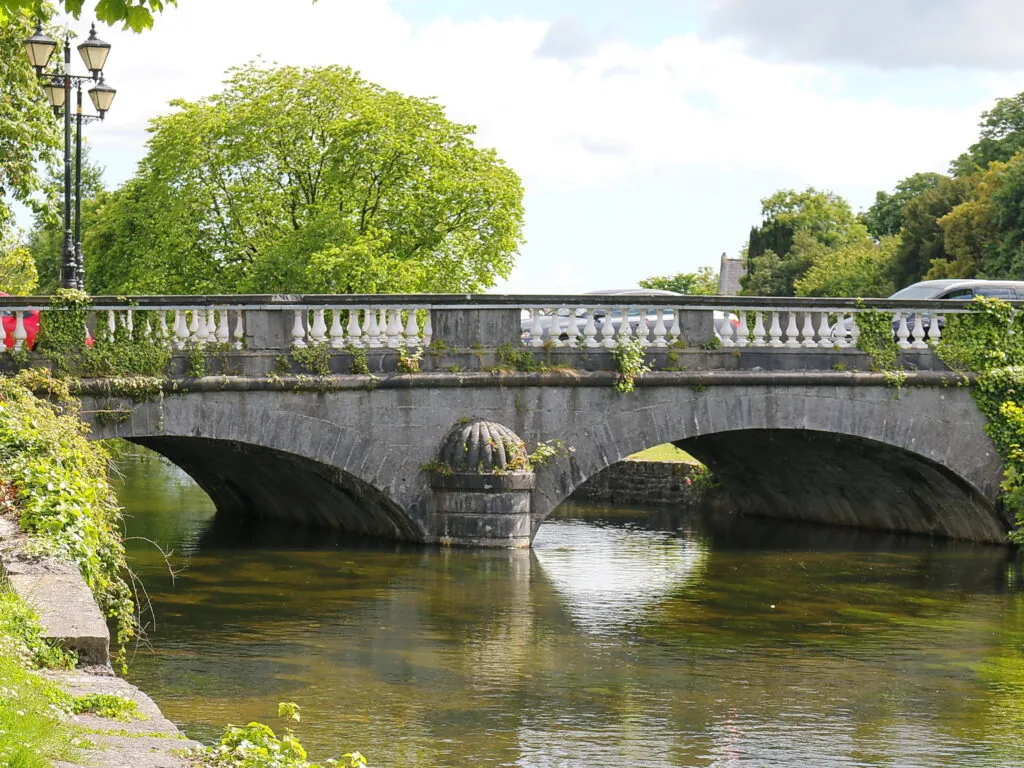
Galway city lies at the head of the bay, at the mouth of the River Corrib. Despite its rapid development, it retains a compact historic centre lined with pedestrian streets, colourful façades and lively pubs.
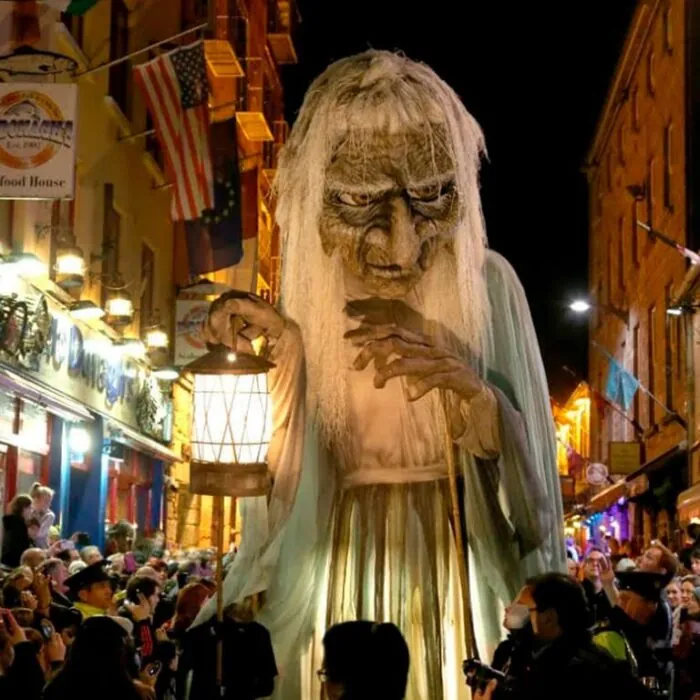
The Latin Quarter forms the city’s tourist heart. Its streets lead to St Nicholas’ Collegiate Church, the Spanish Arch and the quays of the Corrib. Musicians and street performers contribute to the lively atmosphere of the centre, particularly during the summer months.
Galway is also an important university city. The presence of students, artists and communities from around the world gives it a cosmopolitan character that contrasts pleasantly with the county’s more traditional countryside.
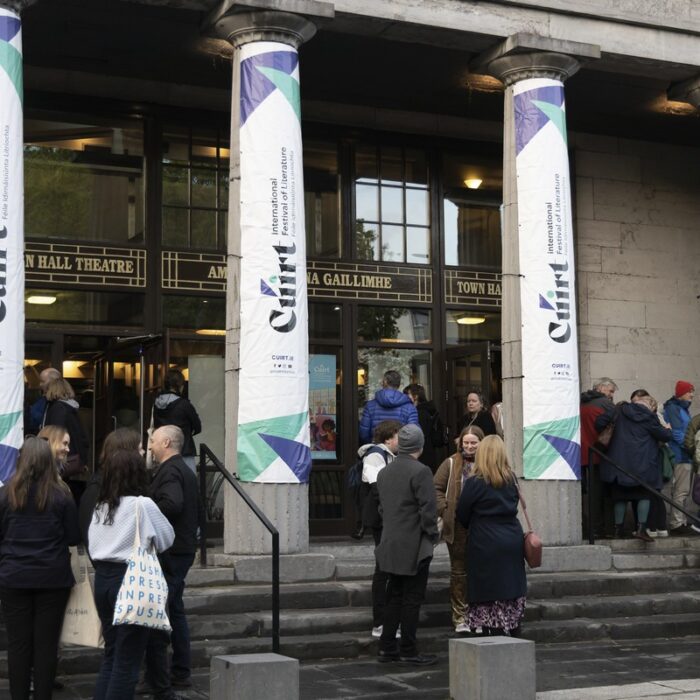
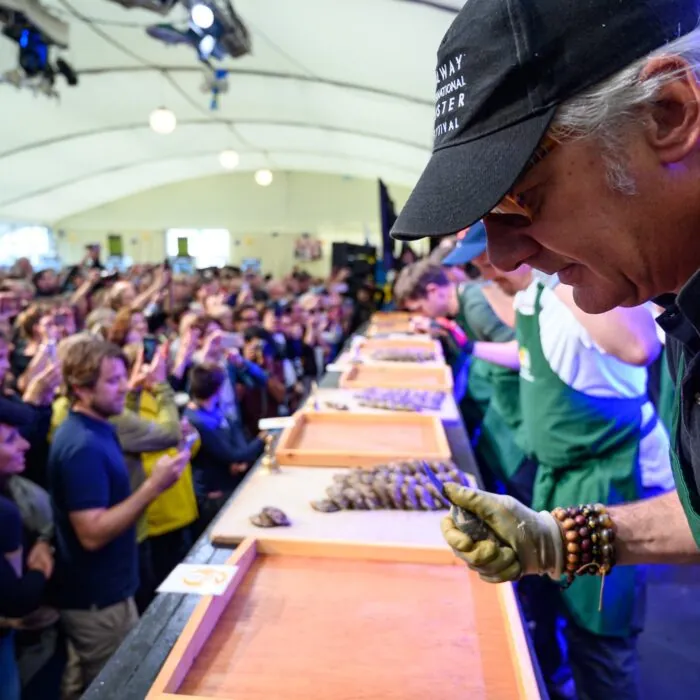
The city hosts several major events, including the Galway International Arts Festival, the Galway Races and the Galway International Oyster and Seafood Festival. Its cultural scene earned it the title of European Capital of Culture in 2020.
Exploring Connemara
Dark mountains, bogs and lakes with ever-changing reflections
Connemara occupies the western part of County Galway. Its boundaries do not correspond to a precise administrative division, but this historic and cultural region has an immediately recognisable identity.
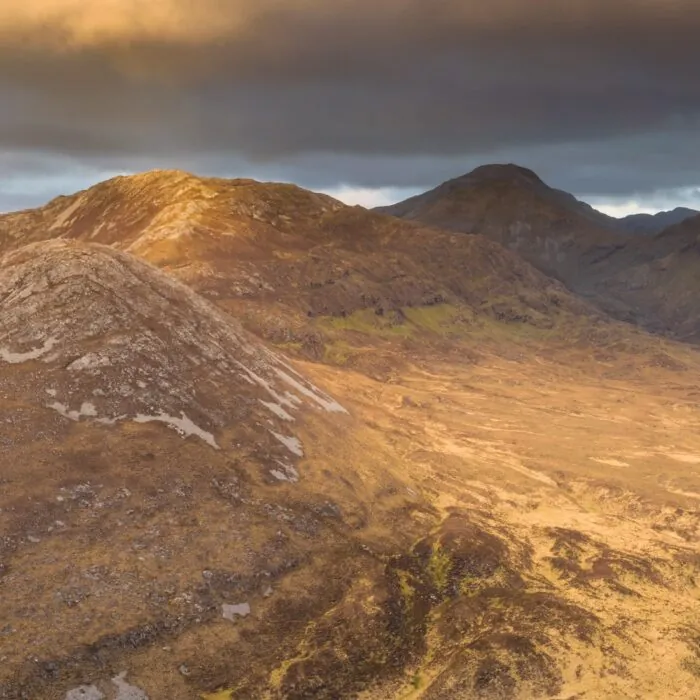
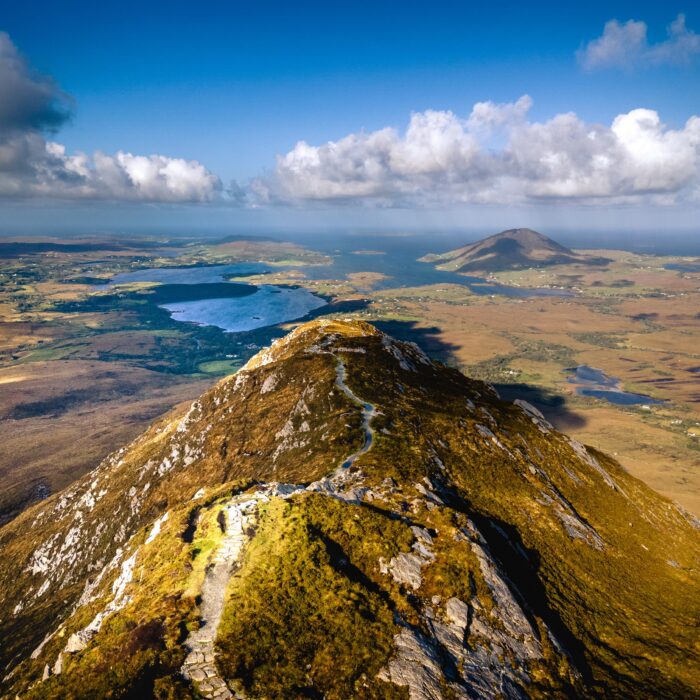
The landscape combines the Twelve Bens, the Maumturk Mountains, bogs and numerous lakes. Grey rock, dark water and russet grasses create a setting whose colours constantly change with the light.
Connemara National Park protects part of this environment around Letterfrack. Several trails have been laid out there, including the climb to Diamond Hill. From its heights, views extend towards the Twelve Bens, Kylemore Abbey and the islands offshore.
Connemara is not, however, simply an empty wilderness. Its stone walls, old farms, harbours and villages bear witness to a long-established adaptation to a land where the soil is thin and weather conditions can sometimes be difficult.
The villages of Connemara
Communities settled between lakes and the coast
Clifden is generally regarded as the capital of Connemara. This colourful small town brings together shops, restaurants, pubs and galleries. It is a convenient base for exploring the Sky Road, the Aughrus Peninsula and the beaches of the west.
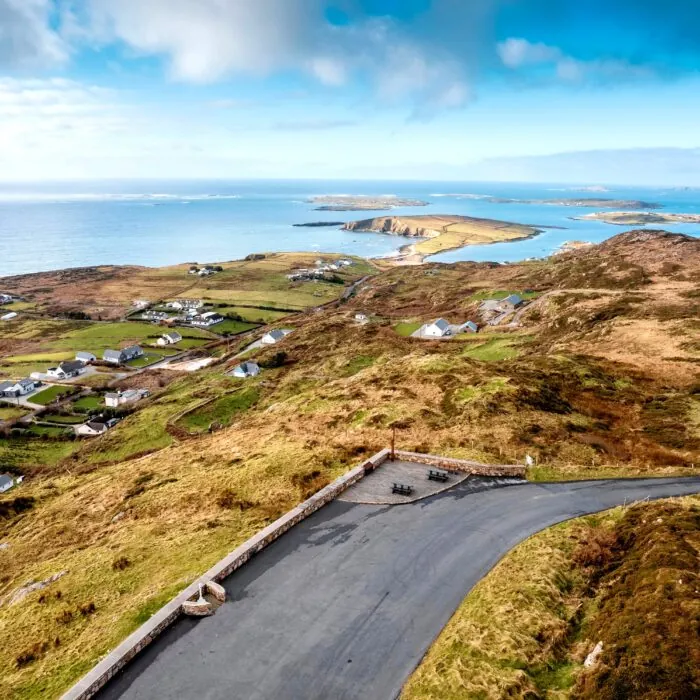
The Sky Road forms a scenic loop overlooking Clifden Bay. The upper section of the route offers beautiful views of the islands, pastures and rugged coastline. The road’s modest dimensions nevertheless call for careful driving.
Roundstone is a small harbour facing the mountains. The village is known for its colourful houses, craft workshops and seascapes. Gurteen Beach and Dog’s Bay are a few kilometres away. Their clear waters and pale sand contrast with the surrounding bogs.
Further north, Letterfrack provides access to the national park, while Leenane lies at the head of Killary Harbour. This long inlet, enclosed by mountains, is generally described as one of Ireland’s few fjords.
Kylemore Abbey
A romantic castle beside a lake
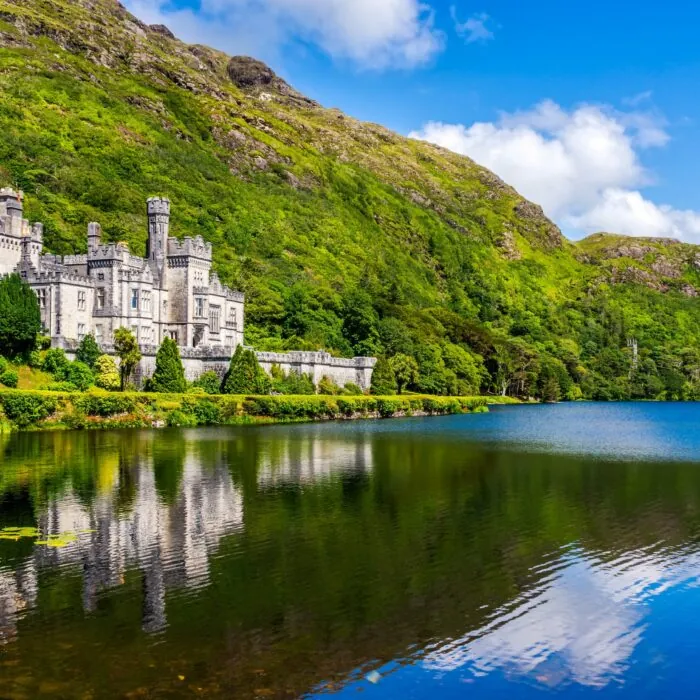
Kylemore Abbey is one of the most photographed monuments in County Galway. Its imposing façade is reflected in the waters of Pollacapall Lough, at the foot of the Connemara mountains.
The building was constructed in the nineteenth century by Mitchell Henry, a British doctor and businessman, for his wife Margaret. It later became a Benedictine abbey when nuns from Belgium settled there in 1920.
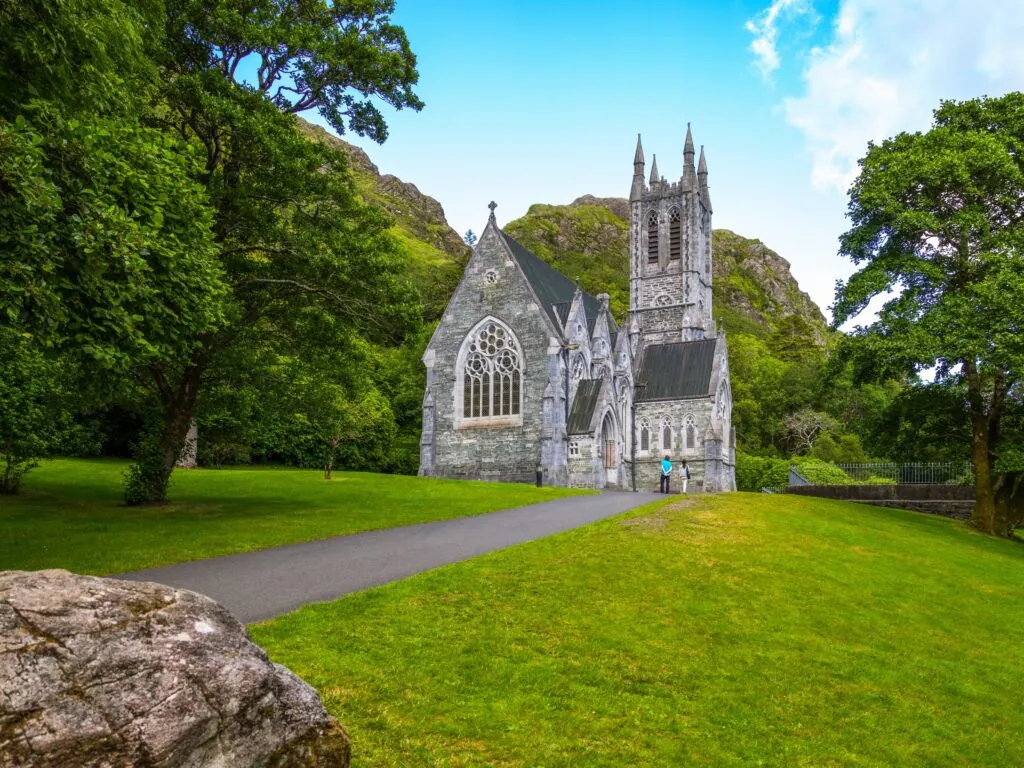
A visit allows you to discover several restored rooms, a neo-Gothic church and a large enclosed Victorian garden. Part of the estate remains occupied by the Benedictine community.
Despite its appearance as an old castle, Kylemore is therefore not a medieval fortress. It is a Victorian residence designed to frame the landscape as much as to provide a home.
The Aran Islands
Three stone islands off Galway Bay
The Aran Islands lie at the entrance to Galway Bay. The archipelago comprises Inis Mór, Inis Meáin and Inis Oírr. These three islands combine limestone landscapes, stone walls, cliffs and archaeological sites.
Inis Mór is the largest and most visited. It is home to Dún Aonghasa, a prehistoric fort built on the edge of a cliff overlooking the Atlantic. The island can be explored by bicycle, on foot or by minibus.
Inis Meáin has a more secluded atmosphere. It is associated with an important Irish literary tradition and retains many paths bordered by stone walls.
Inis Oírr, the smallest, is recognisable by its lighthouse, ruined castle and the rusting wreck of the MV Plassy. Its size means that much of it can be discovered in a day.
The islands belong to the Gaeltacht, and Irish remains in everyday use there. Their relative isolation has helped preserve a maritime culture, architecture and traditions that differ from those of the mainland.
The Irish language in Galway
The country’s largest Irish-speaking region
County Galway has Ireland’s largest and most populous Gaeltacht. It stretches from the west of Galway city to Connemara and also includes the three Aran Islands.
According to Údarás na Gaeltachta, more than 50,000 people lived in the Galway Gaeltacht at the time of the 2022 census. However, language proficiency and daily use vary considerably from one locality to another.
In the westernmost areas, road signs and place names are often given only in Irish. Irish-language media are also based in the region, notably the TG4 television channel and Raidió na Gaeltachta.
This culture is not frozen in the past. It is expressed through music, media, education, artistic creation and contemporary economic life.
Lough Corrib and the county’s interior
A vast lake between Galway and Mayo
Lough Corrib is one of the largest lakes in the Republic of Ireland. It extends north of Galway city and continues towards County Mayo. Its waters reach the bay via the River Corrib.
The lake is dotted with numerous islands and bordered by villages, farmland and wooded areas. It is particularly known for trout fishing, but it also allows boating and various water-based activities.
On its northern shore lies Cong, a village shared between the counties of Galway and Mayo. Further south, Oughterard is one of the main eastern gateways to Connemara.
Aughnanure Castle stands near the village. This sixteenth-century tower house was one of the strongholds of the O’Flaherty clan, once powerful in the region.
East County Galway
A region of castles, abbeys and countryside
The eastern part of the county has a landscape very different from Connemara. The bogs and mountains gradually give way to farmland, forests and small historic towns.
Athenry retains part of its medieval walls, a Norman castle and the ruins of a former Dominican priory. Its heritage recalls the town’s commercial and strategic importance in the Middle Ages.
Further south, Loughrea developed beside a lake whose shores provide walking routes and water-based activities. St Brendan’s Cathedral is particularly known for its stained glass and its interior associated with the Celtic Revival artistic movement.
At the county’s eastern edge, Portumna overlooks Lough Derg and the River Shannon. Its early seventeenth-century castle, former priory and forest park make it an interesting stop between Galway and the Midlands.
Hiking and outdoor activities
A region made for adventure
County Galway offers numerous hiking routes. Connemara National Park provides waymarked trails, while experienced walkers can explore the Twelve Bens or the Maumturk Mountains.
The Western Way crosses part of the county between Oughterard, Maam Cross and Leenane. This long-distance trail follows old roads, forest tracks and isolated valleys.
The coast is suitable for kayaking, sailing, surfing and diving. Killary Harbour hosts various water-based activities, while the beaches of Connemara are suitable for swimming when conditions permit.
The lakes and rivers also attract anglers. Lough Corrib is renowned for trout, while several waterways in the county hold salmon and freshwater fish.


 +
+
 Tourist attractions
 Irish Restaurants and Pubs
 Partner Accommodations
 Campgrounds and Lodging